























Elevate Your Interiors
with Trendy Tiles Display
Tiles That Speak the Language of Design.
12th Jun, 2026
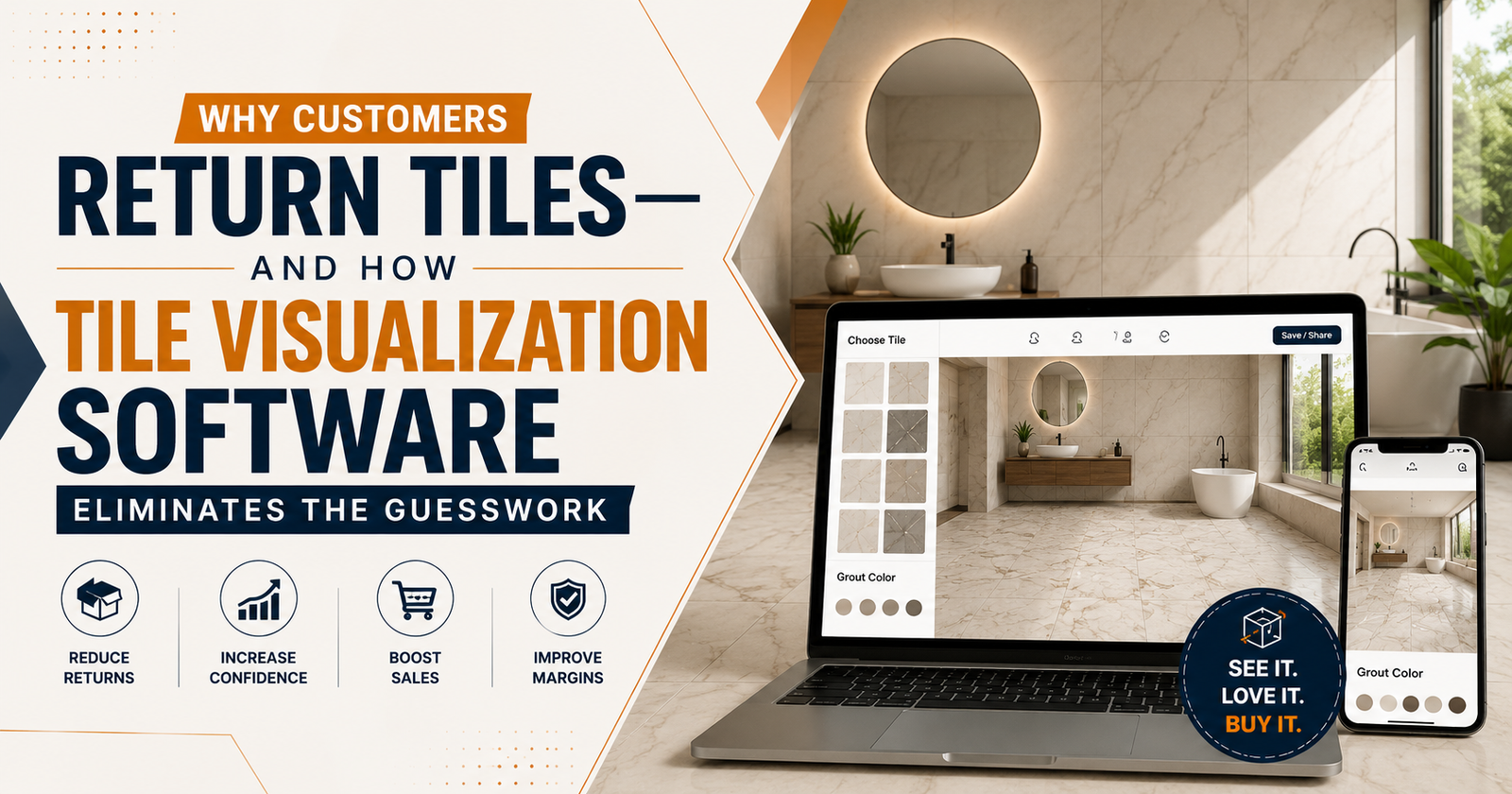
A customer orders 25 square meters of a stunning marble-look porcelain tile. It arrives. They place one piece in the corner of their bathroom, see that it looks completely different from what they expected, and call to request a full return. Sound familiar?
This scenario plays out every day across tile retail and e-commerce, quietly eating into margins that few businesses are tracking carefully. Understanding exactly why customers return tiles and deploying tile visualization software to stop it at the source is one of the highest-ROI decisions a tile business can make in 2026. Let us walk through the full picture.
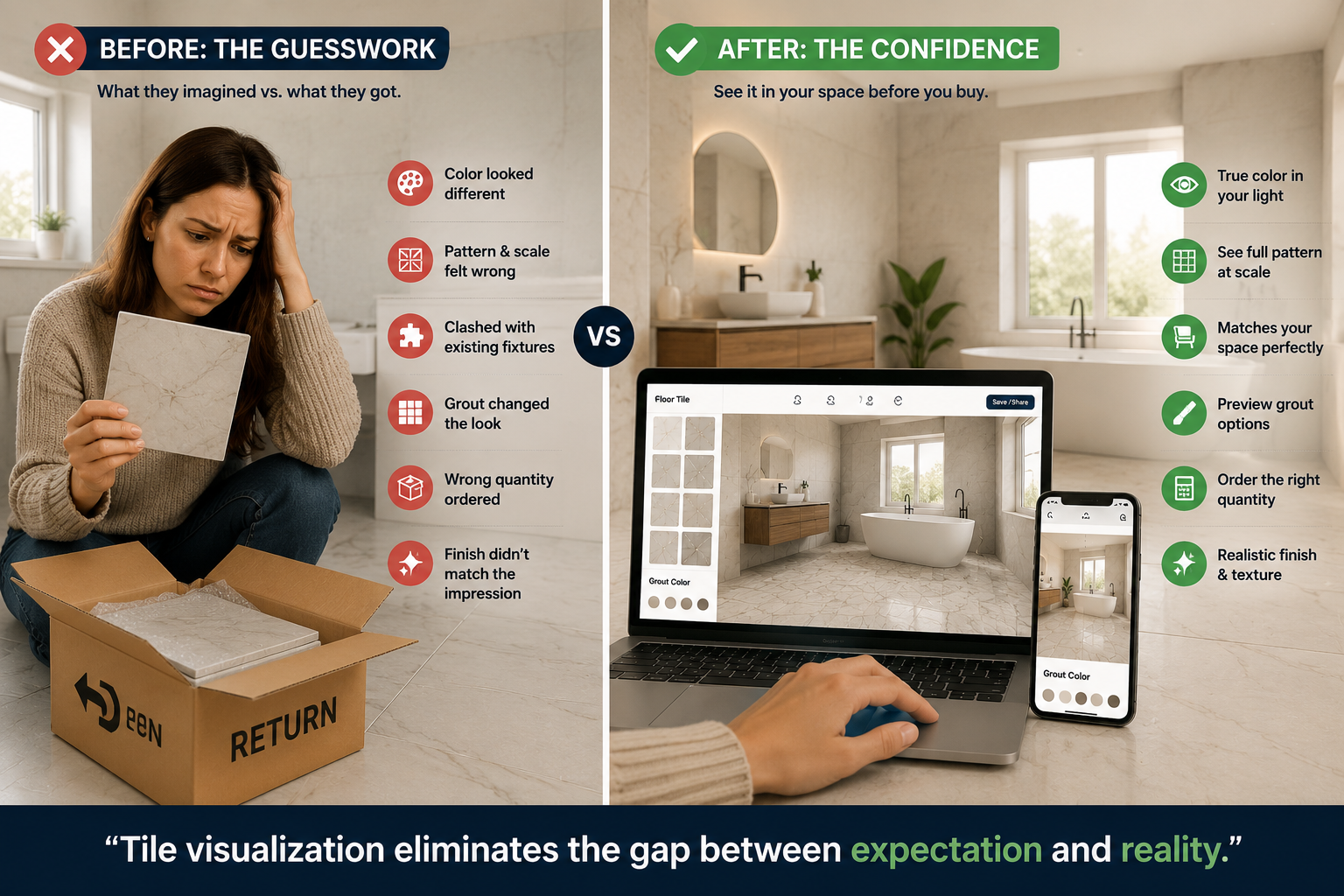
Tile returns are one of the most expensive operational problems in the home improvement retail category. Industry benchmarks consistently place tile and flooring return rates between 15% and 30% for online retail channels. For manufacturers supplying directly to end customers, the figure can be even higher.
The visible cost – inbound shipping, restocking labor, customer service time – is significant. But the invisible costs are larger:
A single tile return on a mid-size residential order can erase the profit from three to five successful transactions. This is not a customer service issue; it is a structural profitability problem that tile visualization software directly solves.
Businesses using tile visualization software report return rate reductions of up to 35%. The mechanism is simple: when customers can see the tile in their own room, there are no surprises when it arrives.
Understanding the root causes of tile returns is the first step. Wrong tile selection accounts for the vast majority, but it breaks down into six specific patterns.
This is the number one driver of tile returns globally. Tile photography is taken under controlled studio lighting conditions. A customer bathroom, kitchen, or living room has entirely different light – warmer, cooler, more shadowed, or flooded with natural sunlight. Under their specific conditions, the tile can read as an entirely different color.
This is not a product quality issue. It is a fundamental limitation of static photography that a tile preview tool solves by mapping the tile into the customer actual room under their actual lighting.
A single 60×60 cm tile sample gives almost no impression of how the repeated pattern will look across 15 square meters of bathroom floor. A design that looks bold and contemporary on a sample card can feel overwhelming at scale. A delicate pattern can vanish into the grout and read as near-solid color across a large surface. The tile matching tool in a room visualizer shows the actual scaled installation, not a single isolated piece.
Most customers are tiling a room that already contains fixed elements: a vanity, cabinetry, a bath, kitchen appliances, or existing flooring that is staying in place. Coordinating a new tile with these elements from a small sample is extremely difficult. Without being able to preview the combination in a virtual tile visualizer, customers are guessing at how finishes will interact. The guess frequently fails.
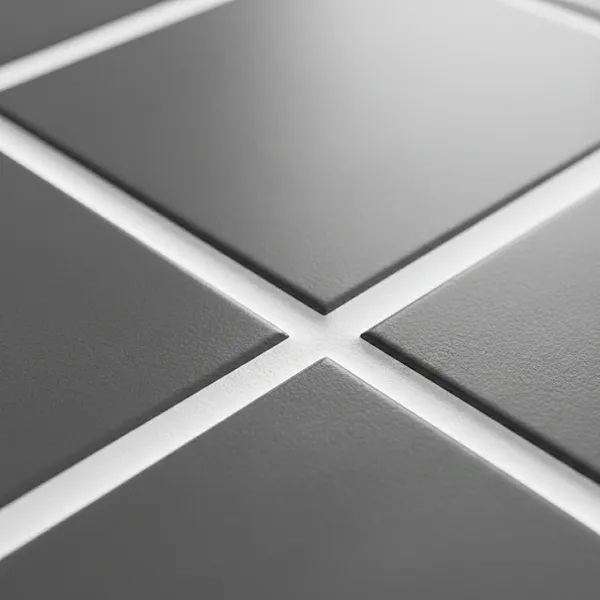
Very few customers think about grout color when ordering tiles. But the color and width of grout lines can completely transform how a tile installation reads. A grey tile with light grout looks entirely different from the same tile with dark grout. Without a tile comparison tool that shows grout variations, customers discover this only after installation – when correction is expensive and disruptive.
Customers are not professional tilers. Calculating the quantity of tiles required, accounting for cuts, wastage, pattern matching, and breakage is genuinely complex without professional guidance. A tile quantity calculator helps, but it does not help customers visualize how the quantity decision affects the room. Both over-ordering (with returns of excess) and under-ordering (with visible batch color differences when reordering) create return and reorder scenarios.
Standard product photography cannot convey the tactile qualities that define premium tiles: the variation in a handmade terracotta, the depth of a high-gloss porcelain under different light angles, the exact texture of brushed slate. Customers expecting one surface quality and receiving another return based on feel and sheen rather than color or pattern. A 3D tile visualization tool with realistic texture rendering substantially reduces this gap.
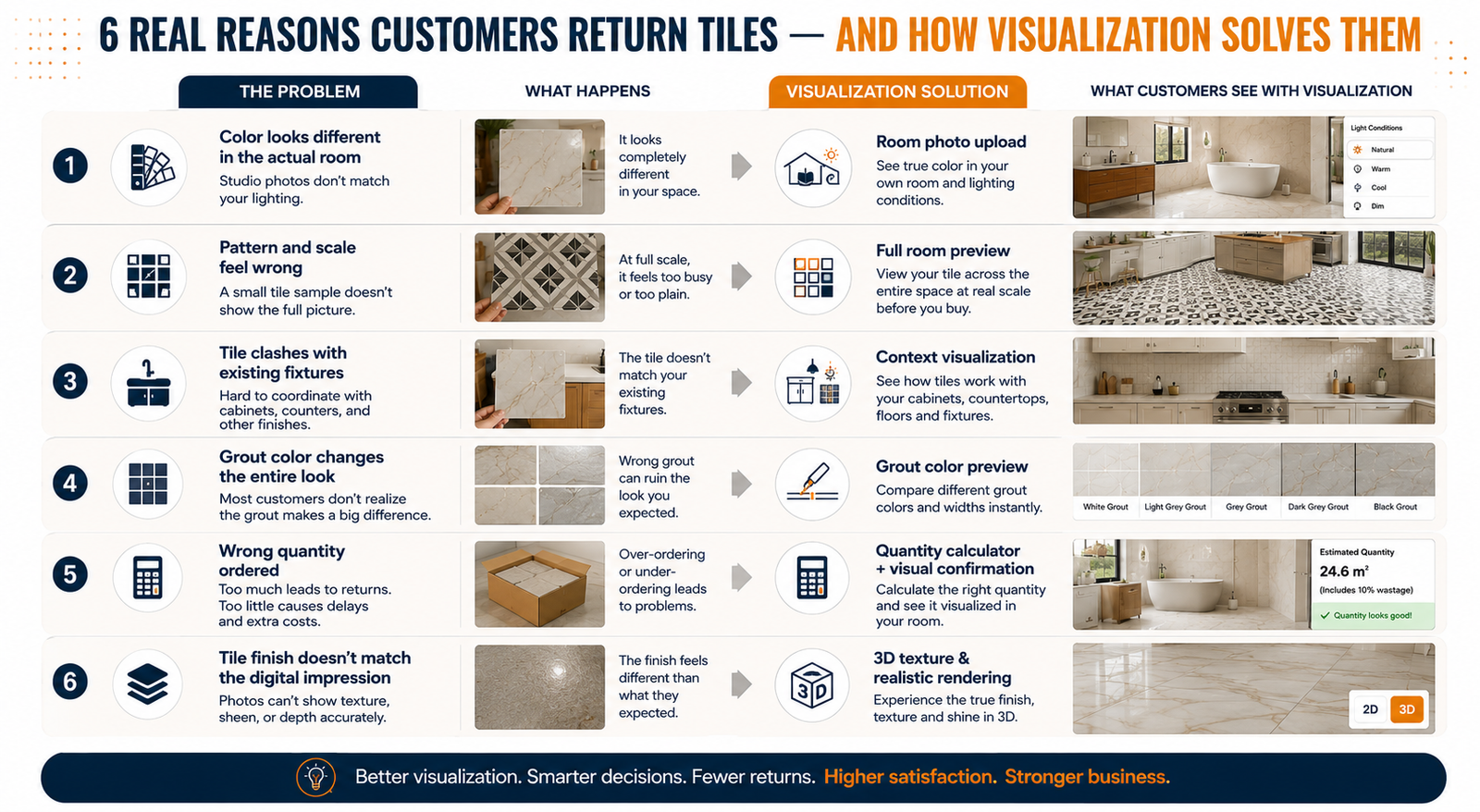
Each of the six causes above has a direct solution in tile visualization software. Here is how the mapping works.
The customer uploads a photo of their actual room. The tile is mapped onto their floor or wall under their room actual lighting. Color accuracy within the customer own environment eliminates the studio-to-reality gap that drives most returns.
The virtual tile visualizer shows the repeated tile pattern across the full surface area exactly as it will look installed. The customer can see whether a bold pattern works at scale or whether a delicate design has the presence they expected.
Because the customer existing room elements are visible in their uploaded photo, the tile sits alongside their actual vanity, cabinets, and flooring, not in a generic studio setting. The tile selection tool shows the real combination, not an imagined one.
TilesDisplay includes a grout color visualization feature that lets users test different grout colors and widths with any tile. The customer sees the finished installation with their chosen grout before ordering – eliminating one of the most common post-installation complaints.
When a customer can see exactly how a tile fills their room in a visual tile selection tool, they have a much more accurate spatial sense of quantity. Combined with a tile quantity calculator, visual confirmation of coverage significantly reduces both over-ordering and under-ordering.
A 3D tile visualization tool renders surface texture, gloss level, and material depth far more accurately than flat photography. Customers see the finish under simulated lighting that reflects their room conditions – not studio-optimized conditions designed to make every tile look ideal.
Beyond reducing returns, tile visualization software directly improves the home renovation planning experience for your customers, and that improved experience translates directly into business outcomes.
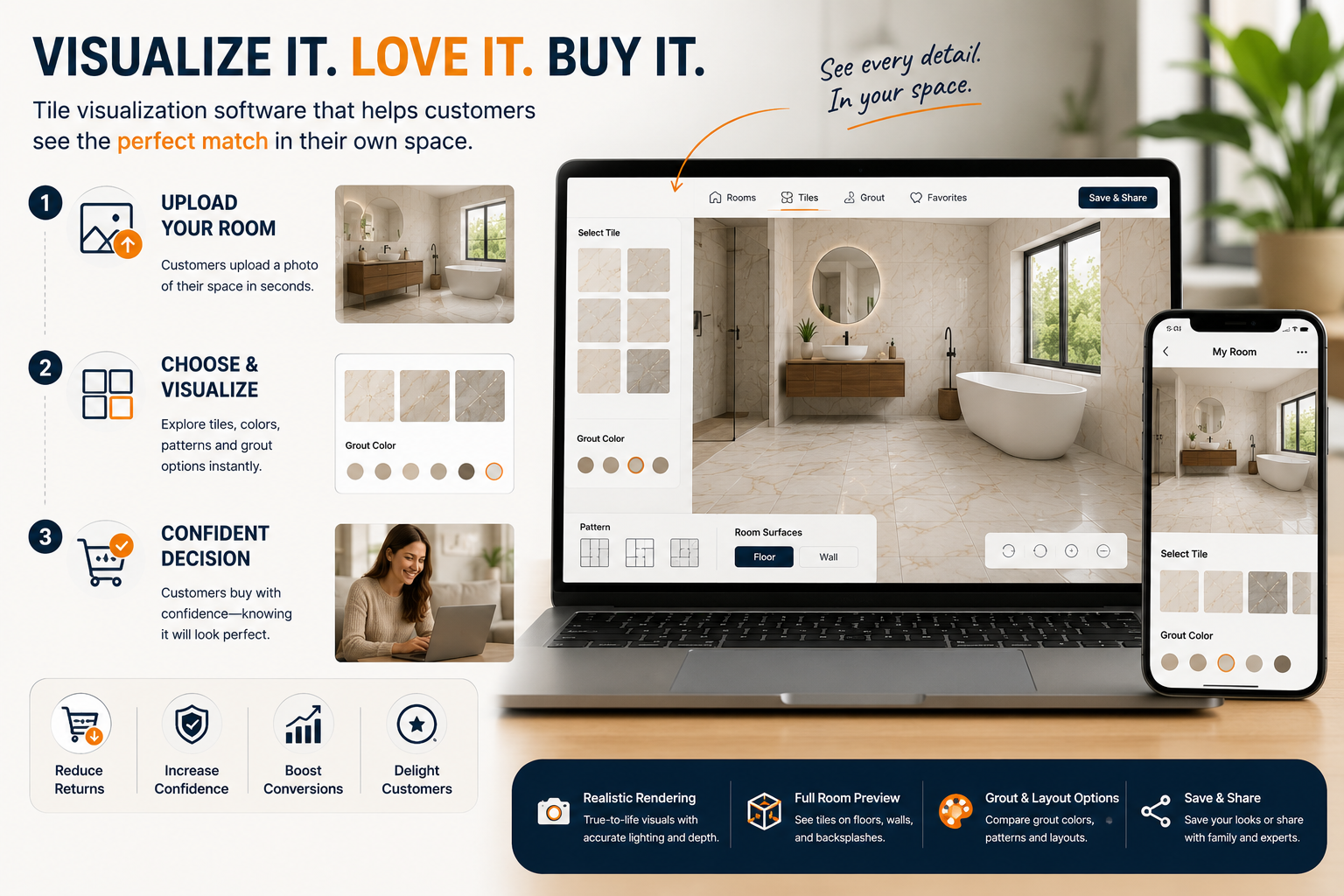
The highest-impact placement. A visualize in your room button on every product page intercepts buyers at the precise moment they are deciding whether to purchase. The tile preview tool answers the one question holding them back.
An in-store kiosk running tile visualization software allows customers browsing your physical showroom to preview any tile, including designs not physically stocked in realistic room environments. Customers who arrive having visualized online and then see the tile in person arrive pre-decided, not undecided.
Sales professionals use the virtual tile visualizer to build pre-meeting presentations for client calls. Sharing visualization links before a meeting means the call is a confirmation conversation rather than a cold introduction.
TilesDisplay wall and floor visualizer → tilesdisplay.in/wall-floor-visualizer
Showroom kiosk solution → tilesdisplay.in/interactive-kiosk
[External link: Baymard Institute e-commerce return rate research → baymard.com]
The most common reason is color mismatch the tile looks different in the customer actual room compared to studio photography or a small sample. Lighting conditions vary significantly between studio and home environments, causing the same tile to read as a noticeably different color.
Tile visualization software lets customers preview tiles in their own room, under their own lighting, alongside their existing fixtures before purchasing. When the tile arrives looking exactly as previewed, there is no reason to return it. Businesses using tile visualization software report return rate reductions of up to 35%.
A tile quantity calculator helps customers order the correct amount, reducing returns from over-ordering and the complications of under-ordering (batch differences). Combined with visualization, customers have both an accurate quantity estimate and a realistic preview of the finished result.
A tile preview tool is a feature within tile visualization software that lets users see how a specific tile design will look applied to a floor or wall surface before purchasing. Most modern tile preview tools also allow grout color testing, layout changes, and room comparisons.
Yes. Commercial tile projects, hotel lobbies, restaurant floors, and office spaces benefit from tile visualization software because project stakeholders can preview large-scale tile applications before approval. TilesDisplay supports commercial room templates and large-format tile visualization.
Tile returns are not an unavoidable cost of doing business. They are the predictable result of asking customers to make a significant visual decision based on a small sample and a photograph taken under conditions that bear no resemblance to their actual room. Tile visualization software solves this at the root cause, not at the return desk.
The businesses that implement a tile visualization platform are not just reducing returns; they are building a purchasing process where returns are structurally unlikely. Every return avoided is a customer kept, a review preserved, and a margin protected.
Which of the six return causes is costing your tile business the most, and have you calculated what reducing your return rate by even 20% would mean for your annual profitability?
Try TilesDisplay free → tilesdisplay.in/signup
Excerpt: Tile returns cost manufacturers and retailers far more than the visible logistics expense. Color mismatch, scale misjudgement, grout surprises, and wrong quantities account for the majority of returns all of which tile visualization software prevents. This guide explains the six root causes of tile returns and exactly how visualization tools eliminate each one.