





























Elevate Your Interiors
with Trendy Tiles Display
Tiles That Speak the Language of Design.
12th Jul, 2026
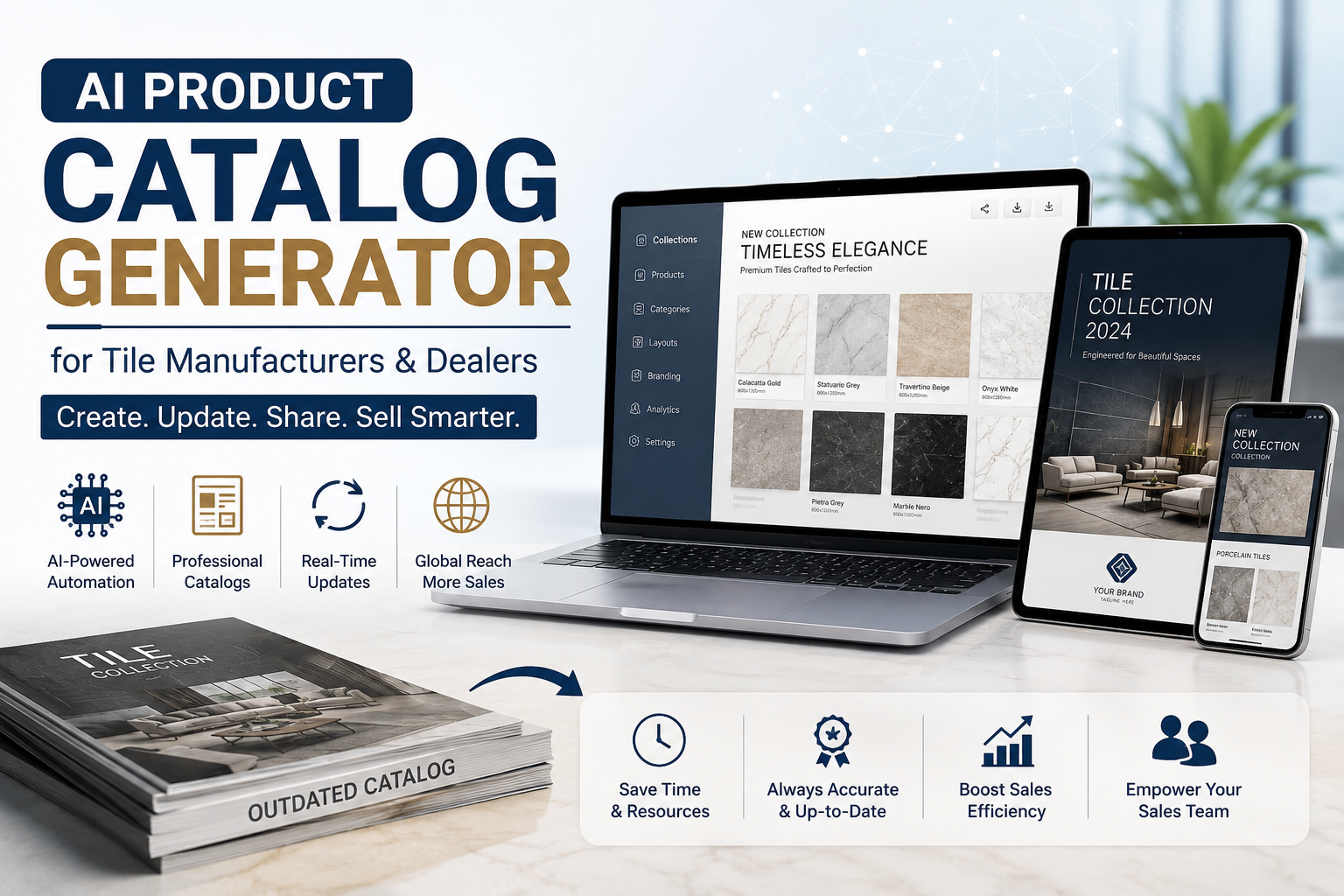
Still Spending Weeks Updating Product Catalogs? AI Has a Better Plan.
Picture this. Your design team has finally completed a beautiful 160-page tile catalog after weeks of revisions. The marketing department approves it, the sales team starts sharing it with dealers, and everyone breathes a sigh of relief.
Then reality strikes.
A new porcelain collection is launched. Five product specifications change. Two finishes are discontinued. Dealers request updated PDFs, architects ask for the latest technical sheets, and suddenly your "final" catalog is already out of date.
If you're a tile manufacturer or dealer, this isn't an occasional inconvenience, it's a recurring business challenge. Product catalogs are meant to showcase your best collections, but keeping them accurate often becomes a full-time job. Every update means more design work, more approvals, more confusion, and more time that could have been spent selling products instead of formatting pages.
This is where an AI product catalog generator changes the game.
Instead of rebuilding catalogs manually every time your product range evolves, AI helps organize product information, generate professional layouts, and create an always-updated digital catalog that your sales team can confidently share anywhere in the world. What once took days—or even weeks—can now happen in hours.
It's no surprise that businesses are embracing AI faster than ever. According to McKinsey, more than three-quarters of organizations now use AI in at least one business function, reflecting how quickly intelligent automation is becoming part of everyday operations. While many industries use AI for analytics or customer service, manufacturers are increasingly adopting it to simplify marketing, product management, and sales workflows.
For tile businesses, that's especially important. Product portfolios continue to grow, customers expect instant information, and dealers need access to the latest collections wherever they are. A static PDF simply can't keep pace with those expectations.
If you're already using a Tile Visualizer to help customers see products in realistic spaces, pairing it with an AI-powered catalog creates an even stronger digital buying experience. Together, they transform how products are presented—from discovery to final decision.
Expert Tip: Your catalog isn't just a marketing document—it's one of your most valuable sales assets. If it isn't updated regularly, you're not only missing opportunities; you're risking customer trust.
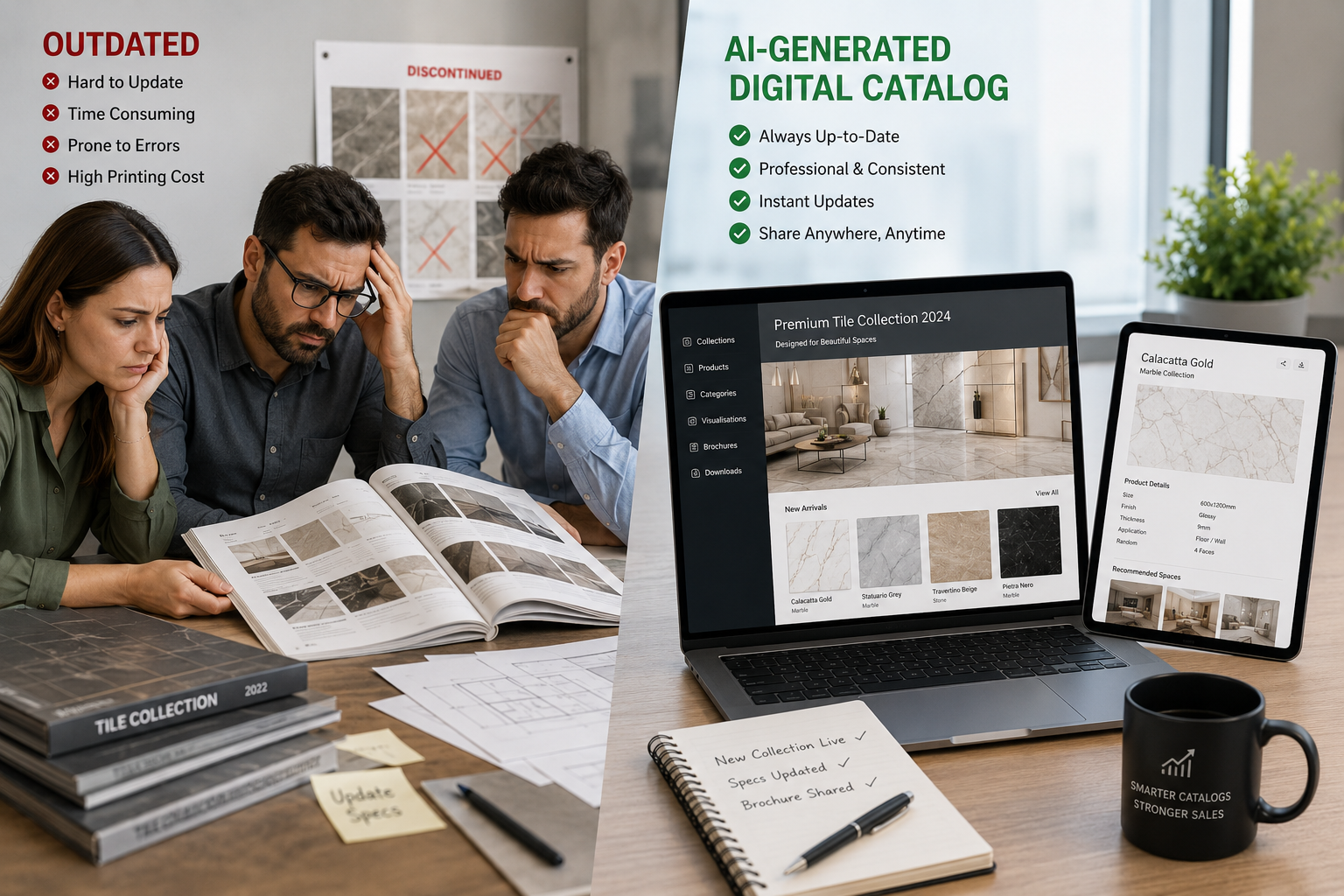
At its core, a product catalog generator is software that transforms product data into a professional catalog without requiring designers to manually build every page. It collects information such as product names, images, dimensions, colours, finishes, specifications, and descriptions, then organizes everything into a structured, visually appealing format.
An AI product catalog generator goes several steps further.
Rather than acting like a simple design template, it understands how products relate to one another. It can automatically group collections by category, recommend page layouts, align branding elements, maintain consistent typography, and keep product information synchronized as your inventory changes.
Think of it as the difference between assembling furniture yourself and buying furniture that's already built. Both get the job done, but one saves a tremendous amount of time, effort, and frustration.
For tile manufacturers, this technology is particularly valuable because catalogs rarely stay static. New collections launch throughout the year, finishes evolve with design trends, and technical specifications are updated to meet changing customer requirements. Every change creates a ripple effect across brochures, PDFs, dealer catalogs, and marketing materials.
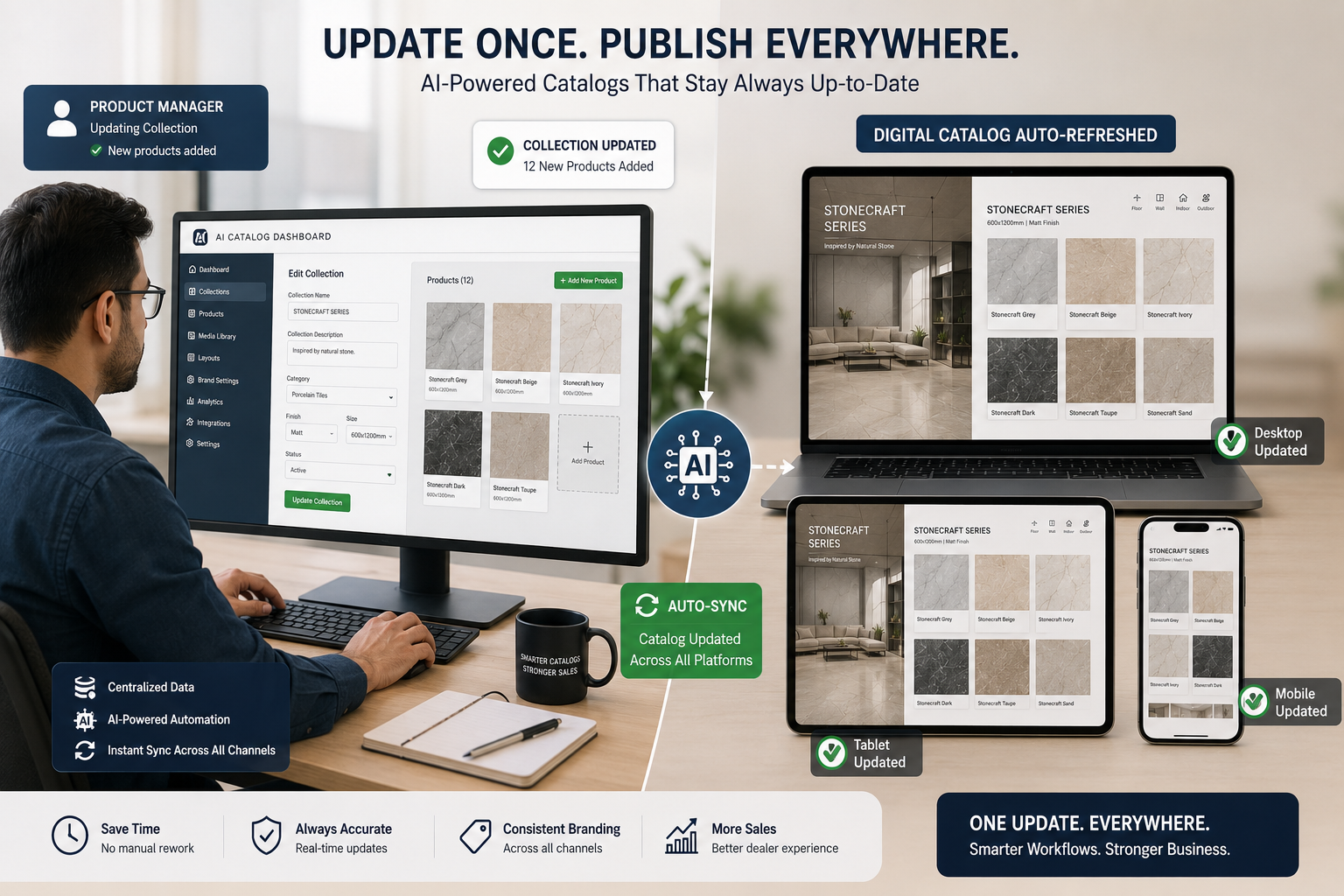
Instead of redesigning everything from scratch, AI works with a centralized product database. Update the product information once, and your catalog generator can automatically reflect those changes across the latest digital catalog. This significantly reduces repetitive work while improving consistency and accuracy.
Another misconception is that AI replaces designers.
It doesn't.
The best AI tools eliminate repetitive production tasks—not creativity. Your marketing team still controls branding, storytelling, imagery, and customer messaging. AI simply handles the repetitive formatting, organization, and updating that consumes valuable time.
That's an important distinction because customers don't buy tiles based solely on specifications. They buy confidence. A clean, accurate, professionally organized catalog makes it easier for architects, builders, designers, and homeowners to compare collections and make informed decisions.
Let's be honest.
Most catalogs look impressive on launch day.
Six months later, they're filled with outdated product codes, discontinued collections, and missing specifications.
The problem isn't poor design.
The problem is maintenance.
A growing tile manufacturer may introduce dozens of new collections every year while updating hundreds of existing products. Managing those changes manually across multiple brochures, dealer catalogs, and regional versions quickly becomes overwhelming.
An AI catalog creator solves this challenge by treating the catalog as a living business asset rather than a static document. Instead of rebuilding pages every time something changes, AI keeps the catalog aligned with your latest product information while preserving a consistent brand identity.
The result isn't just a better-looking brochure.
It's a faster sales process, fewer customer questions, improved dealer confidence, and a product presentation that's always ready for the next opportunity.
This shift is also changing how businesses think about catalogs. They're no longer simply PDFs sent by email—they're becoming interactive experiences that connect customers to room visualizers, technical documents, quotation tools, and digital showrooms in one seamless journey.
Did You Know? Studies consistently show that buyers often research products online before contacting a supplier. A modern digital catalog helps answer many of those questions early, reducing friction and helping sales conversations begin with informed, engaged prospects.
In the next section, we'll look at why traditional catalog creation is quietly costing tile manufacturers time and money, compare it with AI-powered workflows, and explore how a modern product catalog generator is reshaping product marketing across the industry.
Most tile manufacturers don't realize their catalog is costing them money until it starts slowing down sales.
On the surface, everything seems under control. The design team creates an attractive brochure, marketing approves it, and sales begins sharing it with dealers. But behind the scenes, a different story unfolds. Product launches get delayed because the catalog isn't ready. Dealers unknowingly circulate outdated PDFs. Architects request technical specifications that have already changed. Before long, multiple versions of the same catalog are floating around, leaving everyone wondering which one is correct.
The real problem isn't designing a catalog—it's keeping it accurate.
As product ranges expand, manual catalog management becomes increasingly difficult. A manufacturer with 1,000+ SKUs may update collections every few weeks. Every change means replacing images, correcting dimensions, updating finishes, checking product codes, reviewing layouts, and exporting new files. Even a small mistake can lead to customer confusion or costly miscommunication.
Printed catalogs create another challenge. While they still serve a purpose at exhibitions and client meetings, they begin losing value the moment product information changes. Reprinting thousands of copies isn't just expensive—it also delays product launches and increases waste.
This is why more businesses are replacing static brochures with an intelligent digital catalog powered by AI. Instead of redesigning documents repeatedly, they maintain one central source of truth that can be updated whenever products evolve.
Reality Check: The biggest expense isn't printing your catalog—it's losing opportunities because customers are viewing outdated information.
The difference between traditional workflows and AI-powered catalog creation isn't just speed. It's about accuracy, scalability, collaboration, and long-term efficiency.
|
Traditional Catalog Process |
AI Product Catalog Generator |
|
Manual page design |
AI-assisted page generation |
|
Product updates require redesign |
Updates sync automatically from product data |
|
Multiple PDF versions |
One centralized digital catalog |
|
High printing and distribution costs |
Instant online sharing worldwide |
|
Greater risk of human error |
Consistent product information |
|
Time-consuming approvals |
Faster review and publishing |
|
Difficult to manage large product ranges |
Easily scales to thousands of SKUs |
|
Static customer experience |
Interactive and searchable catalog |
This doesn't mean AI replaces your marketing or design team. Instead, it removes repetitive production work so they can focus on branding, storytelling, and launching products faster.
Think of AI as an experienced production assistant. It handles repetitive tasks with consistency, while your team remains responsible for creativity, strategy, and customer engagement.
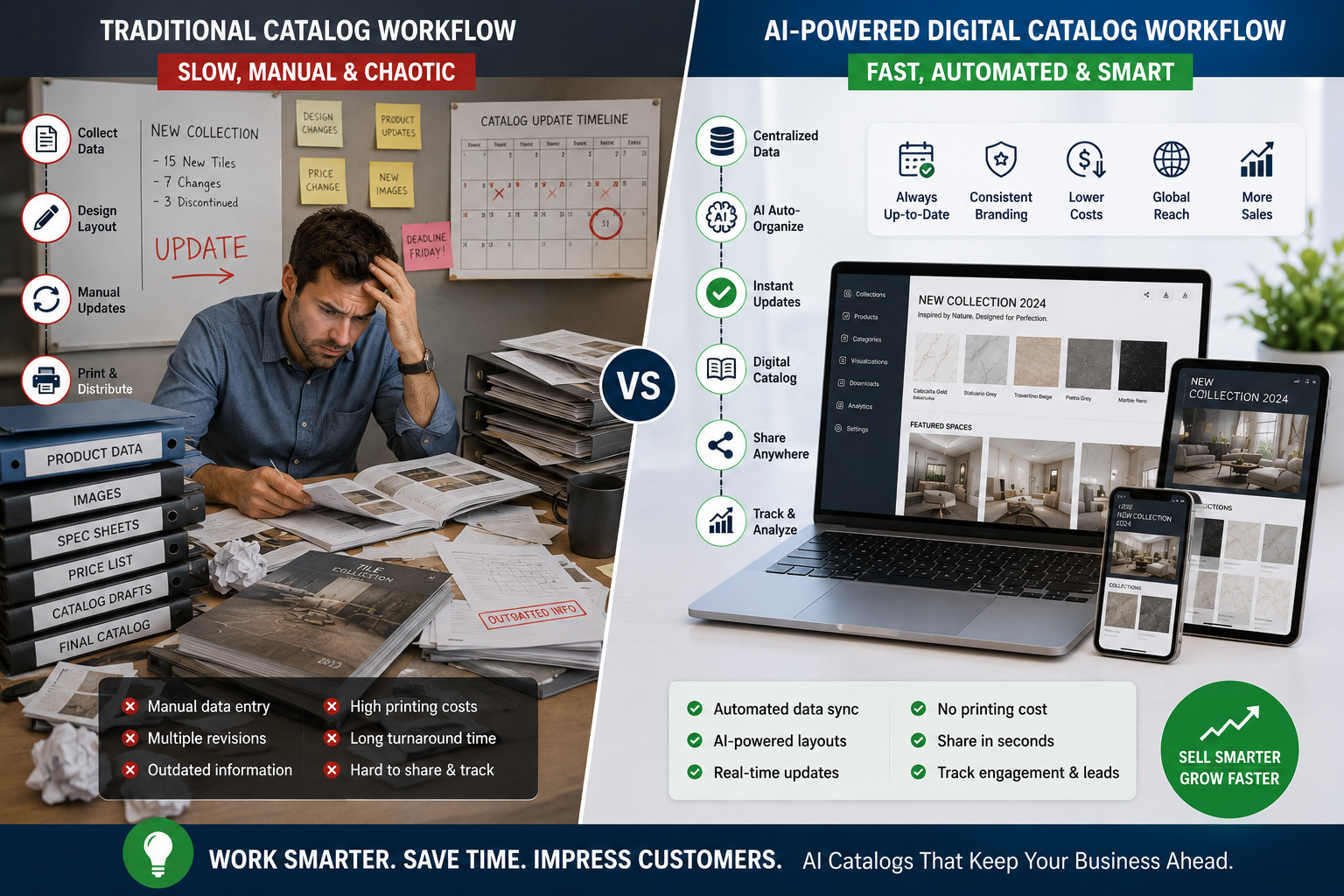
One of the biggest misconceptions is that AI creates catalogs from thin air.
It doesn't.
AI works with the information you already have. Product images, specifications, dimensions, finishes, colours, application details, and branding assets become the foundation of the catalog. Instead of manually arranging each page, AI intelligently organizes this information into a structured and visually consistent presentation.
The process is surprisingly straightforward.
Product Images
│
▼
Product Specifications
│
▼
Central Product Database
│
▼
AI Processing
│
▼
Automatic Layout Generation
│
▼
Brand Styling & Design
│
▼
Interactive Digital Catalog
│
├────────► PDF Export
│
└────────► Online Sharing
Here's what happens behind the scenes.
First, your product information is collected from a centralized source. This may include technical specifications, product descriptions, high-resolution images, dimensions, finishes, colours, and application details. Instead of storing this information across spreadsheets, folders, and emails, AI works from one organized dataset.
Next, the AI catalog creator analyses the information and groups products into logical collections. For example, porcelain tiles may be separated from ceramic collections, while products can also be categorized by finish, size, colour, room application, or design series.
Once products are organized, AI automatically creates layouts based on your branding guidelines. It aligns images, applies typography consistently, maintains spacing, and positions technical information where customers expect to find it. What normally requires hours of manual adjustments happens in a fraction of the time.
Finally, the completed digital catalog can be published in multiple formats. Some businesses export professional PDFs for distributors, while others publish interactive catalogs that include search functionality, clickable navigation, embedded videos, downloadable specification sheets, and direct enquiry options.
The result is a catalog that's easier to maintain, easier to share, and significantly more valuable throughout the customer journey.
Expert Tip: Before adopting any AI solution, organize your product data. Clean images, accurate specifications, and standardized product names dramatically improve the quality of AI-generated catalogs.
Saving time is only part of the story.
The real advantage of an AI product catalog generator is that it changes the way information flows through your business.
Instead of treating the catalog as the final step after product development, AI makes it part of an ongoing digital ecosystem. Marketing teams can publish new collections faster. Sales representatives always access the latest product information. Dealers stop worrying about outdated brochures. Customers gain confidence because they're viewing accurate specifications and current collections.
According to the OECD AI Policy Observatory, artificial intelligence is playing an increasingly important role in helping organizations improve productivity, collaboration, and decision-making across industries. You can explore global AI initiatives and best practices through the OECD AI Policy Observatory: https://oecd.ai
For tile manufacturers competing in a global market, that competitive advantage matters. Faster updates, consistent branding, and a better customer experience don't just improve operations—they help businesses respond more quickly to market demand.
As AI continues to evolve, the catalog itself is becoming more than a document. It's transforming into a connected sales platform that links products, visualizers, technical documentation, and customer enquiries in one seamless experience.
In the next section, we'll explore the features that separate an ordinary catalog generator from an exceptional one, examine why leading tile manufacturers are adopting AI, and reveal the common mistakes that prevent many product catalogs from delivering real business results.
Not every product catalog generator delivers the same value. Some simply arrange products into templates, while others become a central part of your sales and marketing ecosystem. If you're investing in AI, don't settle for software that only creates attractive pages. Look for a solution that helps your business work smarter every day.
The most effective platforms combine automation, flexibility, and scalability. Here are the features that matter most:
The right platform should save time today while supporting business growth tomorrow. Think beyond design. Ask whether the software will still meet your needs when your product range doubles or expands into new markets.
Expert Tip: Choose a platform that grows with your business. Migrating thousands of products to a new system lat
Tile manufacturing has changed dramatically over the past decade. Product ranges are larger, customer expectations are higher, and competition is no longer limited to local markets. A manufacturer in India can easily compete for projects in Europe, the Middle East, Africa, or North America. That opportunity also brings a challenge—keeping product information consistent across every region.
Imagine launching 18 new collections with more than 1,200 SKUs before a major international exhibition. In a traditional workflow, your marketing team would need to update hundreds of pages, replace images, verify specifications, check layouts, export PDFs, and distribute new versions to dealers. Even with an experienced design team, this process could take weeks.
Now imagine uploading the new product information into an AI-powered system. The catalog updates automatically, collections are reorganized, branding remains consistent, and your sales team receives the latest version almost immediately.
That's the real value of an AI product catalog generator. It doesn't just save time—it reduces friction across the entire organization.
Manufacturers also benefit from stronger collaboration. Product managers, designers, sales teams, and distributors work from the same product data instead of relying on multiple spreadsheets and outdated PDF files. Everyone has access to the latest information, reducing mistakes and improving confidence during customer interactions.
There's another advantage that often goes unnoticed: speed to market. In industries where design trends evolve quickly, being able to launch a new collection even a few days earlier than competitors can make a meaningful difference.
Walk into any busy tile showroom and you'll notice the same pattern. Customers rarely ask for a catalog first. They ask questions.
"Do you have this design in a larger format?"
"Can I compare this finish with another collection?"
"Is this available in matte and polished?"
If the salesperson spends several minutes searching through printed brochures or scrolling endless PDF files, the conversation loses momentum. Customers become impatient, and confidence starts to fade.
Now picture a different scenario.
A dealer opens an interactive digital catalog, searches by colour, finish, or tile size, and finds the exact product within seconds. Technical specifications appear instantly. Lifestyle images help customers visualize the design, and a QR code directs them to a room visualizer where they can see the tile in a realistic setting.
The difference isn't just convenience—it changes the buying experience.
Customers receive answers faster, compare products more easily, and feel more confident about their choices. Dealers, in turn, spend less time searching for information and more time understanding customer needs.
Digital catalogs also extend the sales conversation beyond the showroom. Instead of handing out printed brochures that may never be opened again, dealers can share interactive catalogs through email, messaging apps, or links. Customers can revisit products later, discuss options with family or project teams, and return with informed questions.
For architects, interior designers, and contractors managing multiple projects, this accessibility is invaluable. It reduces back-and-forth communication and speeds up product approvals.
Technology alone won't create a great catalog. Even the most advanced AI catalog creator depends on accurate product information and thoughtful planning. After reviewing hundreds of catalogs across the building materials industry, several common mistakes appear again and again.
The first is relying on inconsistent product images. Mixing high-resolution photography with low-quality images weakens the overall presentation and reduces customer confidence.
Another frequent issue is poor product organization. Collections should follow a logical structure that reflects how customers actually search for products—not how files happen to be stored internally.
Outdated specifications create even bigger problems. An incorrect tile size, finish, or application can lead to project delays, unnecessary enquiries, or lost trust. AI helps maintain consistency, but only if the underlying product data is accurate.
Many businesses also overload their catalogs with excessive text. Customers don't want to read lengthy paragraphs about every tile. They want clear specifications, inspiring visuals, and concise descriptions that help them compare products quickly.
Finally, some companies treat their catalog as an isolated marketing document. In reality, it should connect seamlessly with product pages, quotation tools, room visualizers, and enquiry forms. A catalog should guide customers toward the next step—not leave them wondering what to do next.
Reality Check: AI can organize your catalog beautifully, but it can't fix poor product photography or incomplete specifications. The quality of your input still determines the quality of your output.
Before we wrap up, one important question remains: How do you turn an AI-generated catalog into a complete digital selling experience? In the final section, we'll explore how Tilesdisplay connects AI-powered catalogs with interactive room visualization, answer the most common questions businesses ask before adopting AI, and finish with practical takeaways you can apply immediately.
Creating a professional catalog is only the first step. The real challenge begins when customers ask, "How will this tile look in my space?"
That's where most traditional catalogs reach their limit.
A catalog can showcase beautiful product photography and detailed specifications, but it can't help customers imagine a living room with oak-look porcelain flooring or a hotel lobby finished in polished marble-effect tiles. Buyers often need that final layer of confidence before making a decision.
This is where Tilesdisplay stands out.
Rather than offering only an AI catalog creator, Tilesdisplay connects product presentation with visualization. A customer can browse a product inside a digital catalog, open the same collection in a room visualizer, compare layouts, experiment with different tile patterns, and make a more informed decision—all within a connected digital experience.
For manufacturers, this means product launches become more engaging. For dealers, it shortens the sales cycle by answering customer questions visually instead of relying only on printed brochures or lengthy explanations.
Instead of treating catalogs as standalone marketing assets, Tilesdisplay helps businesses create an ecosystem where every digital touchpoint works together:
That combination transforms a catalog from a static document into an active sales tool.
The next generation of catalogs won't simply display products—they'll understand customer intent.
Imagine opening a catalog and searching for "large-format matte tiles for a luxury hotel lobby." Instead of manually filtering hundreds of products, AI instantly recommends suitable collections, displays matching room scenes, and highlights technical specifications relevant to commercial projects.
That's the direction the industry is heading.
Future AI-powered catalogs are expected to include:
For tile manufacturers and dealers, the biggest advantage won't simply be automation—it will be delivering a faster, more intuitive buying experience.
The businesses investing in intelligent product presentation today will be better prepared for tomorrow's digital-first customers.
An AI product catalog generator is software that automatically creates professional product catalogs using product images, specifications, descriptions, dimensions, and branding assets. Instead of manually designing every page, AI organizes products into structured layouts, making it faster to create and update catalogs while maintaining consistency across the entire product range.
No. AI is designed to automate repetitive production tasks, not replace creativity. Designers still make branding decisions, create visual identities, choose imagery, and develop marketing campaigns. AI simply reduces the manual effort involved in arranging layouts, updating specifications, and maintaining consistency across large catalogs.
Both have their place, but they serve different purposes. Printed catalogs remain useful during exhibitions and face-to-face meetings, while a digital catalog offers instant updates, interactive navigation, easier sharing, and worldwide accessibility. Many successful manufacturers now use printed catalogs for brand presence and digital catalogs for everyday sales and product updates.
There isn't a fixed schedule. A catalog should be updated whenever products, specifications, pricing, or collections change. Businesses using an AI-powered catalog generator can make these updates much more efficiently because changes are reflected directly from a centralized product database instead of requiring manual redesign.
Absolutely. Small manufacturers and dealers often have limited design resources, making automation even more valuable. An AI-powered solution helps smaller teams produce professional catalogs without investing significant time in manual design work, allowing them to compete with larger brands while maintaining a polished and consistent presentation.
A modern product catalog generator is no longer just a design tool—it's a competitive advantage. As product portfolios grow and customer expectations continue to rise, relying on static brochures and manually updated PDFs becomes increasingly inefficient. AI enables tile manufacturers and dealers to organize product information more effectively, create professional digital catalogs faster, reduce repetitive work, and keep every catalog aligned with the latest collections. More importantly, it helps customers discover products with greater confidence, giving your sales team a stronger foundation for every conversation.
If you're ready to transform the way you present your tile collections, Tilesdisplay is here to help. Our platform combines AI-powered catalog creation with interactive room visualization, giving manufacturers, dealers, and distributors a smarter way to showcase products and engage customers worldwide. Explore our Digital Catalog and Tile Visualizer solutions, or contact our team to discover how you can modernize your product presentation and create exceptional buying experiences that drive business growth.