






















Elevate Your Interiors
with Trendy Tiles Display
Tiles That Speak the Language of Design.
12th Jul, 2026
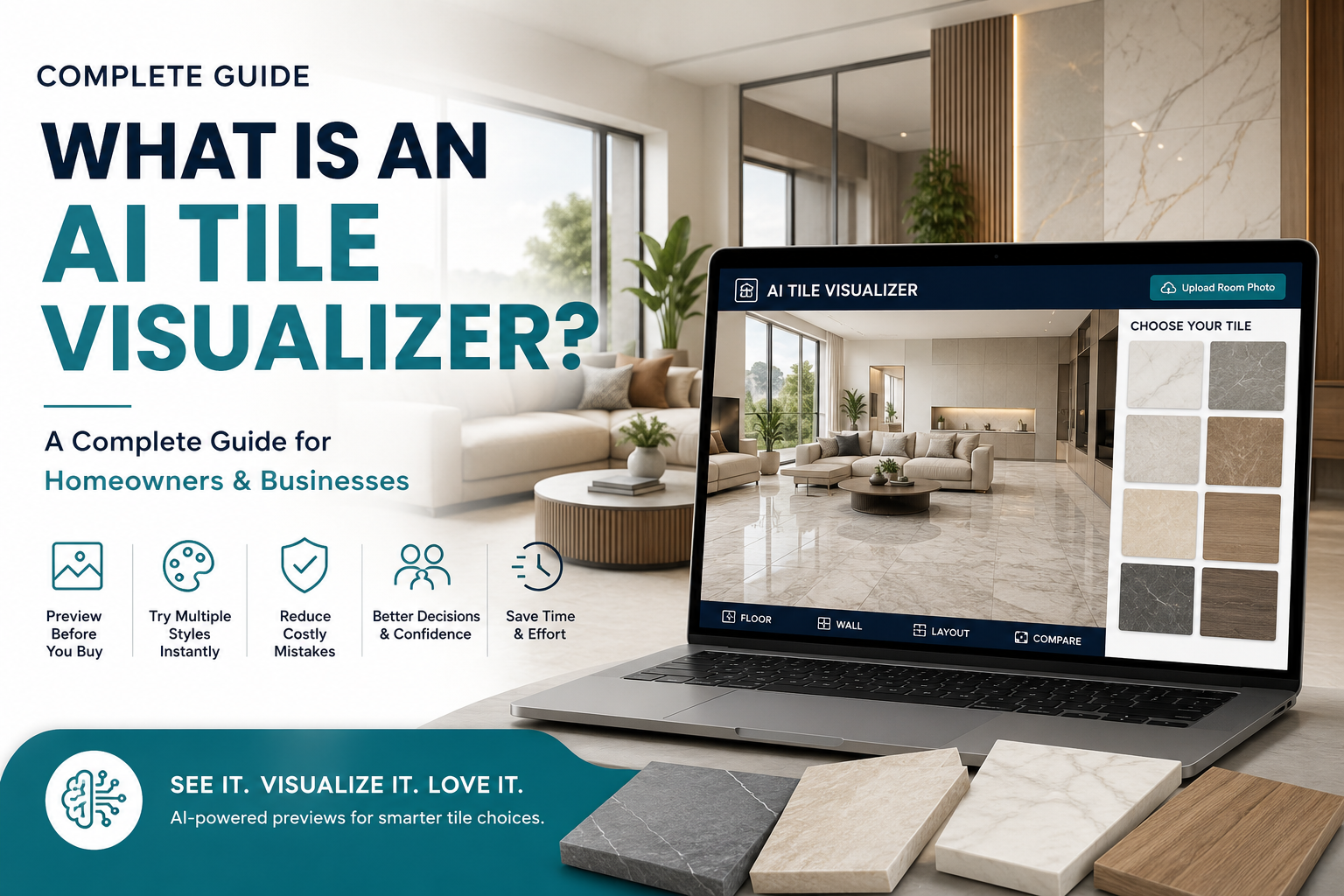
Choosing tiles sounds simple—until you're staring at hundreds of beautiful options that all look perfect in the showroom. The real challenge begins when you ask yourself, "Will this actually look good in my home?" A tile that appears elegant under showroom lighting can feel completely different once it's installed in your living room, kitchen, or office.
That's where an AI tile visualizer changes everything.
Instead of relying on imagination, you can upload a room photo and instantly preview different wall and floor tiles inside your own space. Whether you're renovating a bathroom, designing a luxury villa, updating a retail showroom, or planning a commercial project, AI-powered visualization helps you make confident decisions before investing in materials.
Over the past few years, we've seen homeowners spend hours comparing physical samples while architects and tile retailers struggle to communicate design ideas effectively. The biggest challenge has never been choosing beautiful tiles—it's been helping people visualize the final result. AI solves that problem by replacing uncertainty with realistic previews.
If you're exploring modern ways to compare tile collections before installation, check out our AI Tile Visualizer to experience realistic room previews using your own space.
An AI tile visualizer is software that uses artificial intelligence to place digital tile designs onto photographs of real rooms or professionally designed templates. It allows homeowners, architects, designers, retailers, and manufacturers to preview wall and floor tiles before installation, reducing guesswork, improving buying confidence, and creating a faster, more accurate design process.
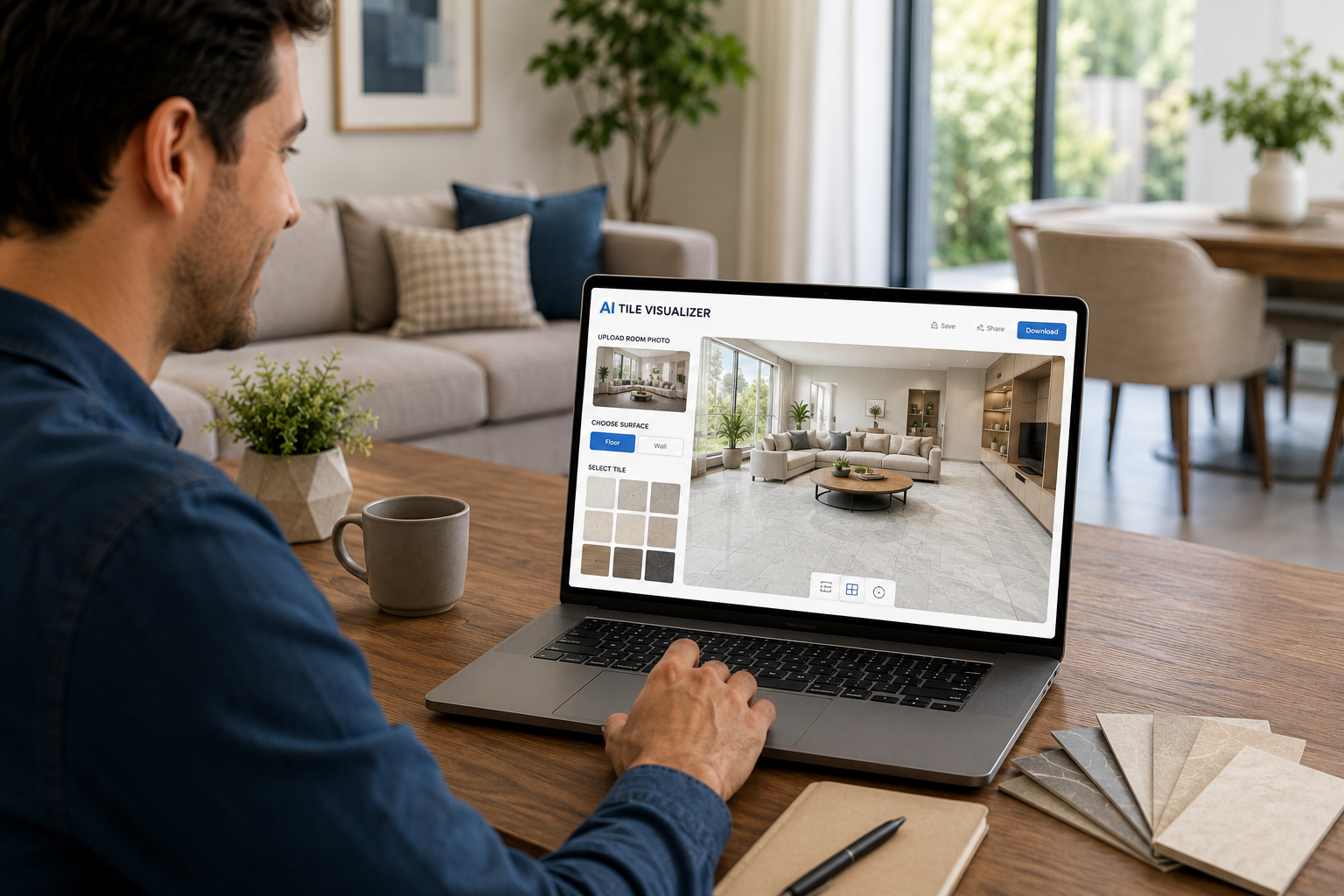
Preview tiles before buying using your own room photo.
Compare different colours, sizes, layouts, and finishes instantly.
Reduce expensive installation mistakes.
Improve collaboration between homeowners and design professionals.
Help tile retailers and manufacturers increase customer confidence.
Save time while making smarter design decisions.
An AI tile visualizer is an intelligent design tool that allows users to see how different tile collections will look inside a real room before making a purchase. Instead of relying on imagination or small physical samples, artificial intelligence creates a realistic digital preview by applying selected tiles to walls and floors while maintaining proper scale, perspective, lighting, and grout spacing.
Think of it as a virtual fitting room—but for your home or commercial project.
Just as online eyewear retailers let customers try on glasses digitally, an AI tile visualizer allows you to experiment with flooring, wall tiles, backsplashes, patios, and commercial interiors without lifting a single tile.
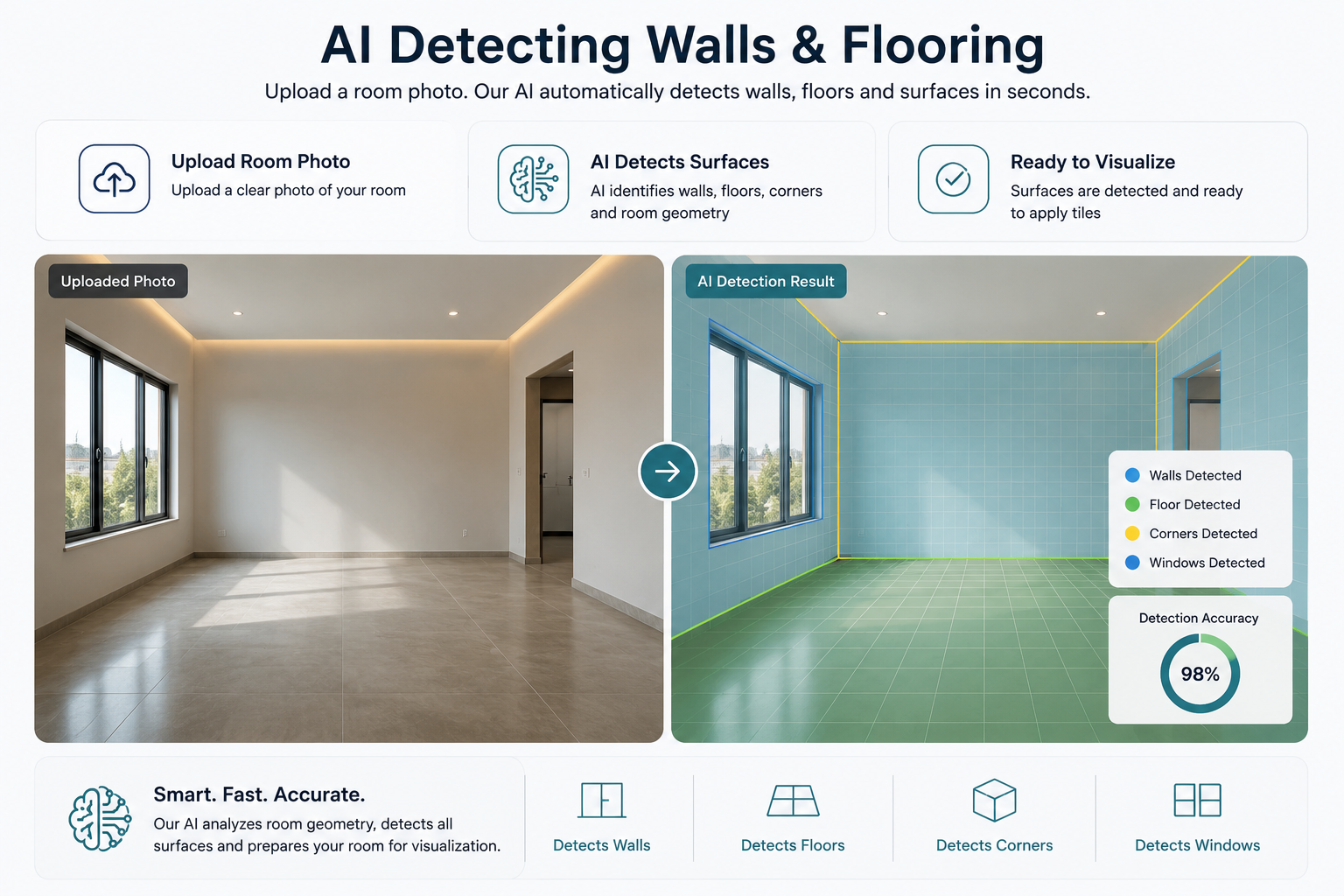
Unlike traditional visualization software, modern AI understands room geometry. It detects walls, floors, corners, windows, furniture, and viewing angles automatically, creating previews that closely resemble the finished installation.
This technology has become an essential tool for:
Rather than replacing professional expertise, AI enhances the decision-making process by helping everyone involved see the same vision before installation begins.
Buying tiles has traditionally involved a lot of guesswork. Customers visit multiple showrooms, collect samples, compare colours under different lighting conditions, and try to imagine how everything will come together in their own homes.
Unfortunately, our brains aren't always good at visualizing large spaces from small samples.
A polished porcelain tile may look stunning under showroom lights but appear darker in a naturally lit kitchen. A marble-look wall tile that complements a display setting may feel overwhelming inside a compact bathroom. Even grout colour can dramatically change the finished appearance.
This is why many homeowners experience "buyer's uncertainty" before placing an order.
An AI tile visualizer eliminates much of this uncertainty by allowing users to visualize their room before committing to a purchase. Instead of imagining possibilities, they see realistic outcomes.
Traditional room design software required manual editing, graphic design skills, or complex CAD programs. AI has completely transformed that experience.
Modern AI-powered visualization software automatically identifies important elements within a room photograph, including floors, walls, corners, and perspective lines. It then intelligently maps selected tile designs onto those surfaces while maintaining realistic proportions and lighting.
The difference is significant.
|
Traditional Tile Selection |
AI Tile Visualizer |
|
Depends on imagination |
Shows realistic room previews |
|
Small physical samples |
Full-room visualization |
|
Time-consuming comparisons |
Instant design changes |
|
Limited showroom displays |
Unlimited digital collections |
|
Higher buying uncertainty |
Greater purchase confidence |
Instead of asking customers to trust their imagination, AI provides visual proof before installation.
Consumer expectations have changed dramatically. Buyers now expect the same digital convenience when selecting building materials that they experience when shopping for furniture, paint colours, or eyewear online.
Across the construction and interior design industries, visualization technology is becoming an important part of the buying journey because it helps reduce uncertainty before purchase. Homeowners can confidently compare styles, designers can present ideas more clearly, and businesses can create more engaging customer experiences through realistic digital previews.
As AI continues to evolve in 2026, visualization is shifting from being a useful marketing feature to becoming a standard decision-making tool for residential and commercial projects alike.
If you're planning a renovation and want to upload your room photo to compare wall and floor tiles instantly, explore our Room Visualizer to experience realistic virtual room design before installation.
If you're planning a renovation and want to upload your room photo to compare wall and floor tiles instantly, explore our Room Visualizer to experience realistic virtual room design before installation.
For most homeowners, choosing tiles isn't just about colour or texture—it's about confidence. Tiles become a permanent part of your home, and replacing them after installation is both expensive and time-consuming. That's why an AI tile visualizer has become one of the most valuable tools in modern home renovation.
Instead of laying physical samples across the floor or trying to imagine how a small tile will look across an entire room, you can see the finished result before placing an order. Whether you're renovating a compact apartment or building your forever home, AI helps remove uncertainty from every design decision.
In our experience, homeowners who use visualization tools tend to compare more design options before making a final choice, but they also make decisions faster because they're selecting based on realistic previews rather than guesswork.
One of the biggest advantages of AI-powered visualization is personalization. Rather than relying on generic showroom displays, you can upload your room photo and instantly apply different tile collections to your actual walls and floors.
This simple feature changes the entire buying experience.
Your room has unique lighting, furniture, wall colours, and dimensions that no showroom can replicate. By visualizing tiles within your own environment, you gain a much clearer understanding of how different materials, finishes, and colours will work together.
Whether you're planning a kitchen makeover, renovating a bathroom, updating your living room, or redesigning an outdoor patio, seeing the final look before installation provides peace of mind that traditional shopping simply can't match.
Renovation mistakes are rarely inexpensive. Ordering the wrong tile colour, choosing an unsuitable layout, or discovering that a finish doesn't suit the room after installation can quickly increase project costs.
An AI tile visualizer helps minimize these risks by allowing you to test multiple possibilities before making a purchase.
Key advantages include:
Instead of purchasing several sample boxes or revisiting multiple showrooms, you can narrow your choices digitally and order with greater confidence.
The value of AI visualization extends far beyond residential projects. Today, manufacturers, retailers, architects, builders, and interior designers are using visualization technology to improve customer engagement, simplify communication, and shorten sales cycles.
Instead of explaining how a tile might look, businesses can show exactly how it appears inside a realistic room. That visual clarity helps customers make informed decisions much faster.
We've seen digital visualization transform showroom conversations. Rather than spending an hour moving sample boards around, sales teams can present multiple room designs within minutes. Customers ask better questions, compare options more efficiently, and often reach purchasing decisions with greater confidence.
Tile retailers often manage hundreds—or even thousands—of products. Displaying every collection physically isn't practical, but digital visualization removes that limitation.
An AI tile visualizer allows retailers to showcase their complete catalogue without expanding showroom space. Customers can browse products digitally, compare collections instantly, and even continue their design journey after leaving the showroom.
Many retailers now use QR codes that allow customers to reopen their saved designs at home, making the buying experience seamless across online and offline channels.
This approach creates a more engaging shopping experience while reducing decision fatigue.
Manufacturers face a different challenge. They need distributors, dealers, architects, and international buyers to understand how products will look once installed.
Instead of presenting isolated tile samples, manufacturers can display complete room settings that demonstrate scale, pattern continuity, and design possibilities.
This is especially valuable for exporters, where buyers may never visit a physical showroom. A realistic digital presentation allows manufacturers to showcase new collections globally while maintaining a consistent brand experience.
For companies launching seasonal collections, visualization software also speeds up product marketing by creating realistic room scenes without constructing physical displays.
Businesses that implement interactive 3D or augmented reality experiences often see measurable improvements in customer engagement. Industry data shows that shoppers who interact with 3D product experiences are more likely to explore products in detail, while retailers commonly report higher purchase confidence and improved conversion rates compared with traditional product images.
Design professionals spend a significant amount of time communicating ideas to clients. Sketches, mood boards, and CAD drawings are valuable, but they often require clients to imagine the finished result.
An AI visualizer bridges that gap.
Instead of asking clients to trust the concept, architects and interior designers can present fully visualized rooms showing flooring, wall finishes, tile layouts, grout colours, and decorative combinations.
This improves collaboration, reduces misunderstandings, and speeds up project approvals.
From luxury homes and hotels to offices, hospitals, restaurants, and retail stores, visualization has become an essential presentation tool for modern design professionals.
One of the most searched features today is tile visualizer upload photo, and for good reason.
Uploading your own room photo creates a far more personalized experience than designing within a generic template. AI automatically recognizes floors, walls, corners, and perspective, then maps selected tiles naturally across those surfaces.
The result feels authentic because you're seeing your own home—not someone else's.
This feature is especially useful when comparing subtle colour variations, large-format tiles, natural stone finishes, or patterned collections that may appear very different depending on room size and lighting.
Whether you're renovating a studio apartment or a luxury villa, personalized visualization leads to more confident decisions.
Bathrooms are often smaller spaces where every design decision has a noticeable impact. Tile colour, size, finish, and layout all influence how spacious the room feels.
Using a bathroom tile visualizer, you can compare:
Rather than relying on imagination, homeowners can see exactly how these combinations work together before installation begins.
The kitchen has become one of the most important spaces in modern homes, making material selection more important than ever.
A kitchen tile visualizer allows users to experiment with flooring, backsplashes, feature walls, breakfast areas, and dining spaces within a single digital preview.
This helps ensure that cabinetry, countertops, lighting, and tile finishes complement one another, creating a balanced overall design.
Because kitchens receive heavy daily use, visualization also supports practical decision-making by allowing users to compare different finishes before investing in long-term materials.
Although both tools use the same AI technology, they solve different design challenges.
A wall tile visualizer focuses on vertical surfaces, helping users compare feature walls, bathroom installations, kitchen backsplashes, and decorative cladding.
A floor tile visualizer, on the other hand, emphasizes room flow, tile size, layout direction, and how flooring connects different spaces within a property.
Many modern visualization platforms combine both features, allowing users to redesign an entire room rather than viewing walls and floors separately.
Physical showrooms remain an important part of the buying journey because they allow customers to feel textures and inspect tile quality firsthand. However, they cannot show every product inside every type of room.
That's where AI adds value.
|
Traditional Showroom |
AI Tile Visualizer |
|
Limited display space |
Unlimited digital collections |
|
Physical samples only |
Realistic room previews |
|
Depends on imagination |
Upload your own room photo |
|
Difficult to compare many options |
Instant side-by-side comparisons |
|
Available during business hours |
Accessible anytime, anywhere |
|
Manual decision-making |
AI-assisted visualization |
Rather than replacing physical showrooms, AI enhances them by adding context to every product.
Consumer expectations have changed. Today's buyers want interactive, personalized experiences before making important purchases.
Whether someone is shopping for furniture, paint, flooring, or tiles, they increasingly expect to visualize their room before committing to a final decision.
This shift explains why virtual room design has become one of the fastest-growing technologies in the home improvement industry.
For homeowners, it builds confidence. For retailers, it increases engagement. For manufacturers, it expands product presentation. For architects and designers, it simplifies communication.
Most importantly, it transforms tile selection from a process of imagination into a process of informed decision-making.
Not every visualization platform delivers the same experience. Some tools simply overlay a tile image onto a room photo, while others use advanced artificial intelligence to recognize room dimensions, perspective, lighting, and surfaces for a far more realistic preview.
If you're investing in tiles for your home or showcasing products to customers, choosing the right AI tile visualizer can save time, improve decision-making, and reduce costly mistakes. The ideal platform should be accurate, easy to use, and flexible enough to support everything from a simple bathroom renovation to a large commercial project.
From our experience in the tile and interior design industry, users value simplicity as much as advanced technology. A tool that delivers realistic results in minutes will always outperform one that requires hours of manual adjustments.
The best AI visualization software does much more than display tile designs. It creates an interactive planning experience that helps users make confident decisions.
When comparing platforms, look for features such as:
A platform that combines these features creates a smoother journey from inspiration to installation.
Artificial intelligence is incredibly capable, but the quality of the final visualization still depends on how you use it. Following a few simple best practices can significantly improve the accuracy of your previews.
Always upload clear, well-lit room photographs whenever possible. Natural lighting produces the most realistic results, while blurry or low-resolution images can affect surface detection. It's also helpful to compare several tile sizes and layouts instead of focusing only on colour, as proportions can dramatically influence how spacious a room feels.
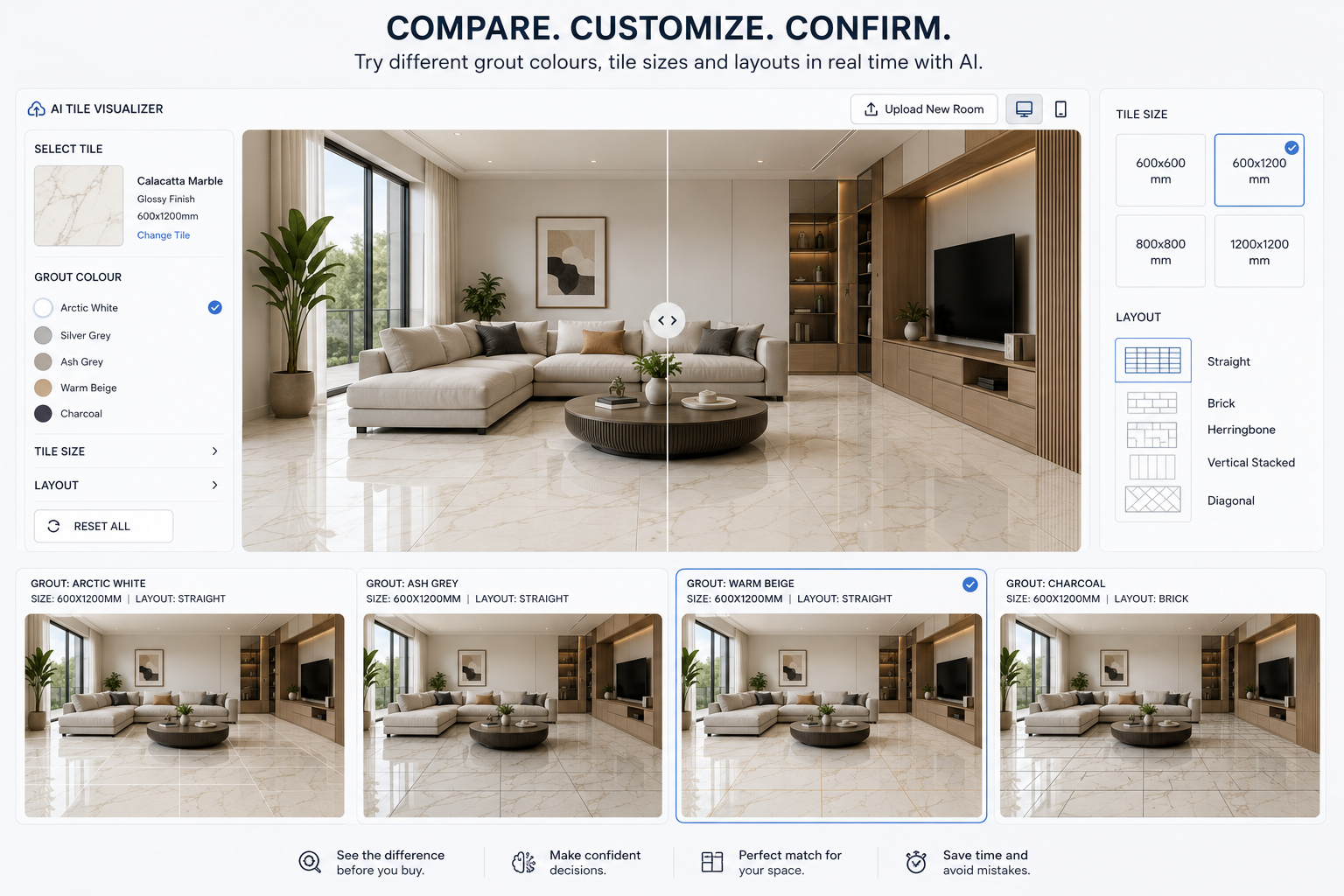
We also recommend testing different grout colours. Many homeowners are surprised to discover that grout can completely change the appearance of the same tile. A subtle grey grout creates a very different effect from bright white or charcoal, especially with large-format tiles.
Finally, remember that visualization is a planning tool. While it provides a highly realistic preview, requesting a physical tile sample is still worthwhile if you want to confirm texture, finish, and material quality before placing a large order.
Even with advanced AI technology, a few common mistakes can lead to misleading results. Fortunately, they're easy to avoid.
Many users select the first tile they like without comparing alternatives. Others focus entirely on colour while overlooking tile size, pattern direction, grout spacing, or lighting conditions. Some compare designs only on mobile devices, where subtle details may be harder to notice.
Avoid these common mistakes:
Taking a few extra minutes to compare multiple designs often leads to much better long-term results.
Sustainability is becoming an important consideration in construction and interior design. While AI visualization is primarily known for improving customer confidence, it also contributes to more responsible purchasing decisions.
When buyers can accurately preview products before ordering, they are less likely to purchase unnecessary materials or replace recently installed tiles because of design dissatisfaction. This helps reduce material waste, transportation, and avoidable renovation work.
Manufacturers also benefit by reducing their reliance on printed catalogues and large physical sample displays. Instead of producing hundreds of promotional boards for every collection, digital visualization allows products to be presented instantly through interactive room scenes.
For businesses focused on sustainable practices, AI visualization supports a more efficient and environmentally conscious workflow without compromising creativity or customer experience.
Choosing an AI tile visualizer isn't just about technology—it's about selecting a platform that simplifies the entire customer journey. That's where TilesDisplay stands out.
TilesDisplay is designed for homeowners, architects, interior designers, tile retailers, manufacturers, exporters, and distributors who want a smarter way to visualize tile collections before installation. Instead of relying on imagination or static product catalogues, users can explore realistic room previews that make design decisions faster and more confident.
One of the platform's biggest advantages is its ability to let users upload their room photo. Rather than working with generic examples, customers can visualize wall and floor tiles inside their own homes, offices, restaurants, hotels, or commercial spaces. Artificial intelligence automatically detects surfaces and applies selected tile collections with realistic scale, perspective, lighting, and grout spacing.
For businesses, TilesDisplay functions as more than a visualization tool—it becomes a digital sales assistant. Retailers can present extensive product catalogues without expanding showroom space, while manufacturers can showcase new collections to distributors and international buyers through interactive room scenes. Architects and interior designers can prepare professional presentations that help clients understand design concepts before construction begins.
The platform also includes features such as side-by-side comparison, tile rotation, layout customization, grout colour selection, and support for both wall and floor visualization. This flexibility makes it suitable for residential renovations, commercial developments, hospitality projects, healthcare facilities, retail environments, and large-scale architectural applications.
Another standout feature is its support for digital showroom experiences. Businesses can integrate QR codes that allow customers to continue exploring saved designs on their own devices after leaving the showroom. This creates a seamless buying journey that combines physical product displays with interactive digital visualization.
In today's competitive market, customers expect personalized experiences before making important purchases. TilesDisplay delivers exactly that by helping users transform uncertainty into confidence, whether they're selecting tiles for a single bathroom or planning materials for an international construction project.
The way people buy building materials has changed dramatically. Buyers no longer want to imagine the final result—they expect to see it.
Across the industry, visualization is becoming an essential part of the customer journey because it shortens decision-making, improves communication, and creates greater confidence before purchase. Retailers increasingly use visualization to engage customers, architects rely on it to explain design concepts, and manufacturers use it to present complete product collections without geographical limitations.
In our experience, the businesses that embrace digital visualization today are better positioned to meet the expectations of tomorrow's customers.
While visualization helps you choose the right design, it's equally important to select materials that are suitable for your project and comply with local construction requirements.
Before finalizing specifications for residential or commercial developments, it's good practice to consult official guidance and work with qualified professionals who understand regional building standards. Depending on your location, local government or building authorities can provide information on construction practices, accessibility requirements, and safety regulations that may influence material selection.
Combining accurate visualization with proper technical planning ensures that your finished project is not only visually appealing but also practical, durable, and compliant.
Artificial intelligence is evolving rapidly, and visualization technology is advancing alongside it. The next generation of AI tile visualizers will move beyond static previews to deliver fully interactive design experiences powered by machine learning, augmented reality (AR), and real-time rendering.
Imagine pointing your smartphone at an empty room and instantly seeing multiple tile collections applied to the walls and floor. Picture collaborating with an architect on another continent while both of you edit the same virtual room in real time. These innovations are no longer futuristic concepts—they are becoming part of the modern design workflow.
As AI continues to improve, visualization tools will become even more intelligent. They will recommend complementary tile collections, suggest layouts based on room dimensions, match grout colours automatically, and even propose complete interior design concepts tailored to individual preferences.
For homeowners, this means easier renovation planning. For businesses, it means better customer engagement and faster sales. For the tile industry as a whole, it marks the beginning of a more connected, data-driven, and visually immersive future.
Yes. A modern AI tile visualizer provides highly realistic previews by recognizing room dimensions, walls, floors, perspective, and lighting conditions. While it isn't a replacement for technical installation drawings, it gives homeowners, architects, and designers an accurate representation of how different tile collections will appear after installation. For the best results, upload a clear, well-lit room photo and compare multiple tile layouts before making your final decision.
Absolutely. One of the biggest advantages of today's AI-powered visualization tools is the ability to upload your room photo. Instead of relying on generic templates, you can preview wall tiles, floor tiles, backsplashes, and feature walls inside your own home or commercial space. This personalized experience helps you compare colours, textures, grout options, and layouts with far greater confidence.
An AI tile visualizer is useful for anyone involved in selecting or presenting tiles. Homeowners can confidently plan renovations, architects can improve client presentations, interior designers can test multiple concepts, builders can explain project ideas more clearly, and tile retailers or manufacturers can showcase complete collections without requiring additional showroom space. Whether you're designing one bathroom or an entire commercial building, visualization simplifies decision-making.
Yes. Many tile manufacturers, distributors, and retailers now use visualization technology to create more engaging buying experiences. Instead of asking customers to imagine how a tile might look, businesses can provide realistic digital previews that reduce uncertainty and speed up purchasing decisions. Features such as tile visualizer upload photo, QR code integration, and digital catalogues also help businesses deliver a seamless online and offline customer journey.
Rather than replacing physical showrooms, an AI tile visualizer enhances them. Showrooms allow customers to experience the texture, finish, and quality of tiles, while AI helps them see how those same products will look inside their own rooms. Combining both experiences creates the most informed buying journey by bringing together physical inspection and realistic digital visualization.
Before making your final tile selection, remember these important points:
AI visualization removes guesswork from tile selection.
Uploading your own room photo creates the most accurate preview.
Comparing multiple tile layouts leads to better long-term decisions.
Visualization benefits homeowners and businesses alike.
Digital room previews improve buying confidence and reduce costly mistakes.
AI is rapidly becoming the new standard for residential and commercial design planning.
Platforms like TilesDisplay make it easier to visualize, compare, and finalize tile selections from anywhere in the world.
Choosing tiles has always been one of the most important—and sometimes most stressful—parts of any renovation or construction project. With so many colours, sizes, textures, and finishes available, relying solely on imagination is no longer enough. An AI tile visualizer transforms that experience by letting you see the finished result before installation begins. Whether you're updating a small bathroom, designing a modern office, or planning a large commercial development, AI-powered visualization helps you make faster, smarter, and more confident decisions. Instead of wondering if a tile will suit your space, you can visualize it instantly and move forward with clarity.
As AI continues to evolve, visualization will become a standard part of the buying journey, helping homeowners and businesses make faster, more informed decisions before installation begins. As AI continues to evolve, visualization tools will play an even bigger role in helping homeowners, architects, retailers, and manufacturers collaborate more effectively. The ability to visualize your room, compare tile collections, and refine every design detail before making a purchase is quickly becoming an industry expectation rather than a luxury.
At TilesDisplay, we believe selecting tiles should be exciting—not uncertain. Our AI-powered platform enables homeowners, architects, designers, manufacturers, and retailers to upload room photos, compare multiple tile collections, customize layouts, experiment with grout colours, and create realistic room previews within minutes.
Whether you're planning a residential renovation, launching a new tile collection, or managing a commercial construction project, TilesDisplay provides the tools needed to make informed decisions with confidence. By combining advanced artificial intelligence, intuitive design tools, and a user-friendly experience, we help transform ideas into realistic visualizations before a single tile is installed.
If you're ready to explore a smarter way to design, try our AI Tile Visualizer today, upload your room photo, and discover how easy it is to create beautiful spaces with confidence. For personalized assistance or business solutions, visit our Contact Us page and connect with our team to learn how TilesDisplay can support your next project.