



















Elevate Your Interiors
with Trendy Tiles Display
Tiles That Speak the Language of Design.
13th Aug, 2026
Choosing the right tile is rarely as simple as finding a design you like. A tile may look perfect in a catalog or showroom sample, yet create a completely different impression when it covers an entire living room floor, bathroom wall, kitchen backsplash, or commercial space. Customers have traditionally depended on physical samples, showroom displays, photographs, and their own imagination to predict the final result.
That becomes even more challenging when a brand offers a large collection of products across different colors, patterns, sizes, finishes, and applications. Customers may find dozens of options they like but still struggle to answer one important question: Which one will actually work in my space?
This is where a tile visualizer can make the selection process more practical. Instead of viewing tiles only as individual products, customers can explore how different designs may look within a room. They can experiment with flooring, wall surfaces, colors, patterns, and combinations before narrowing their choices.
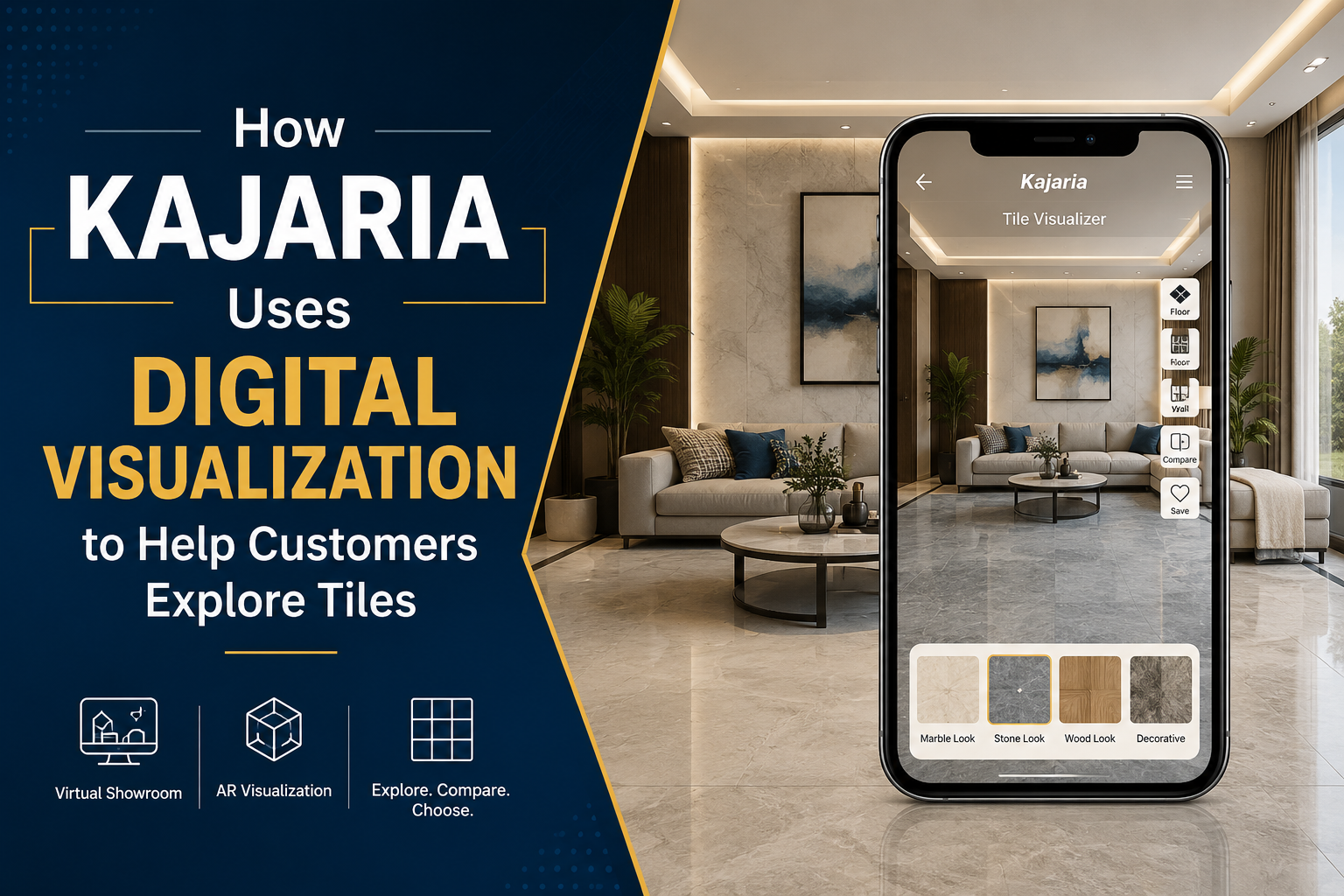
Kajaria provides an interesting real-world example of this shift toward digital tile discovery. The brand has introduced digital experiences including a Virtual Showroom and AR-based visualization, allowing customers to explore tile designs in a more interactive environment. Its digital approach demonstrates how a traditional product category such as tiles can become more visual, interactive, and customer-focused.
The larger lesson is important for the tile industry: when customers can understand a product in the context of their own space, product discovery becomes much easier.
A large product catalog gives customers more choice, but more choice does not automatically make decision-making easier. When homeowners browse a large collection of Kajaria tiles, they may encounter numerous marble-look, stone-look, wood-look, decorative, matte, glossy, patterned, and neutral options.
The problem is that a tile sample only shows part of the story.
A small physical sample can help customers examine:
However, it does not necessarily show what happens when the same design is repeated across an entire room.
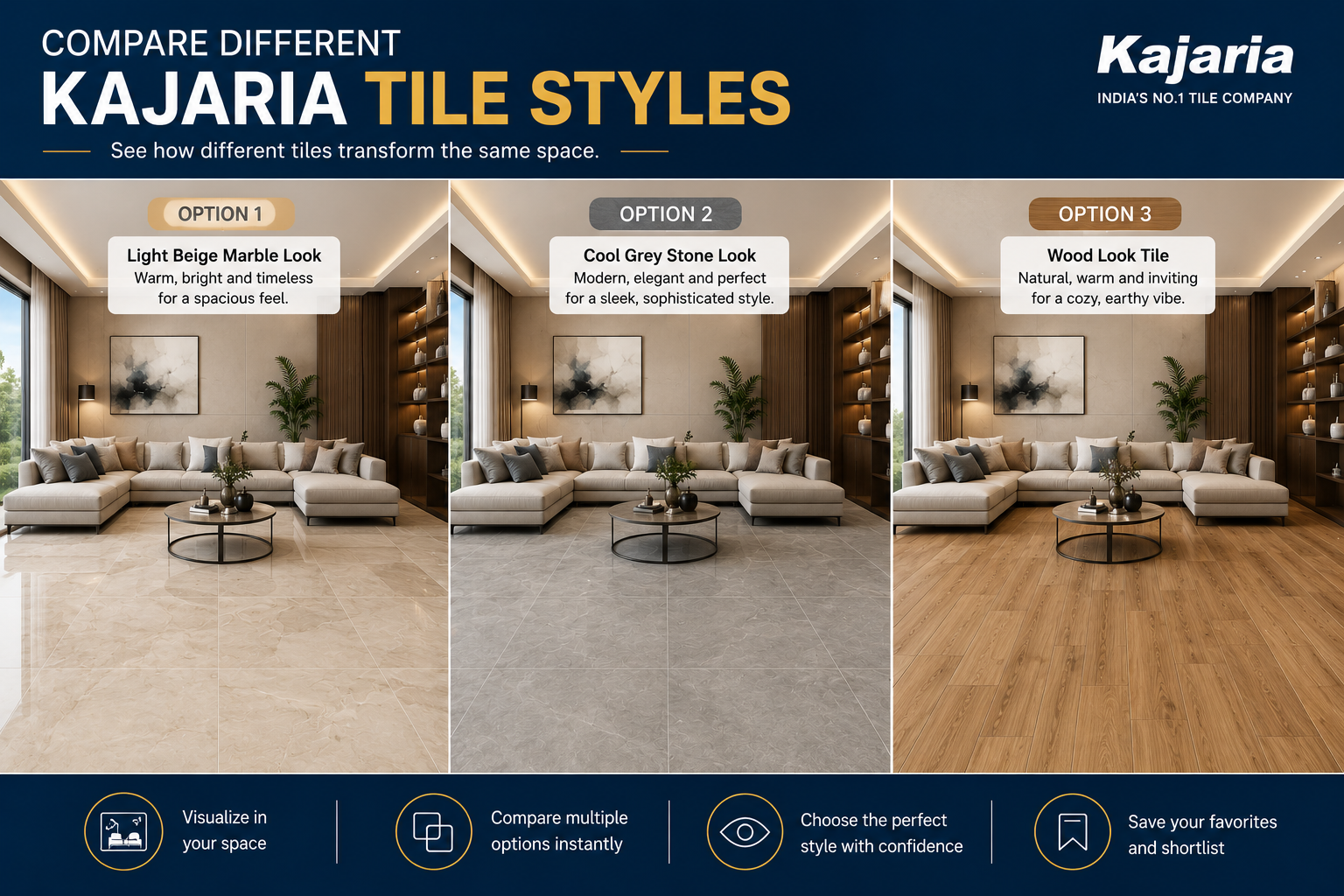
Imagine choosing between three living-room flooring options:
All three might look attractive when viewed individually. But once placed across the floor of the same living room, they can create completely different impressions.
The beige option may make the room feel warmer and brighter. The grey option may create stronger contrast with wooden furniture. The wood-inspired option may introduce a more natural visual character.
This is why traditional product browsing often creates a gap between seeing the tile and understanding the tile in context.
A digital tile visualization experience helps reduce that gap.
A tile visualizer is a digital tool that allows customers to preview tile products within a room or interior environment.
Depending on the platform, users may be able to upload a photograph of their room, select a predefined room, choose a floor or wall surface, and apply different tile products to see how the space changes.
The basic concept is straightforward:
Select a product → Apply it to a space → Compare → Shortlist
This is different from a conventional product page.
A product page primarily answers:
"What does this tile look like?"
A visualizer attempts to answer:
"How could this tile look in my room?"
That second question is often more useful because customers are not buying tiles simply because they like the product photograph. They are buying them because they believe the product will work with their existing interior or planned design.
A modern visualization experience can allow users to experiment with:
The value is not simply that the customer can create an attractive image.
The real value is comparison.
If a customer can compare several possibilities within the same environment, they can eliminate unsuitable options more confidently.
Kajaria is a useful example of how an established tile brand can incorporate visualization into its digital customer journey.
The brand currently promotes a Virtual Showroom and an AR experience that allows users to capture an image of their space and explore different tile designs. Kajaria's digital ecosystem also includes an image-based tile discovery experience that helps users find products based on visual inspiration.
This approach changes the starting point of the customer journey.
Instead of beginning with:
"Which tile should I buy?"
the customer can begin with:
"What could work in this room?"
That difference may appear small, but it changes the way a large catalog is explored.
A customer can start with the room, identify the type of look they want, experiment with different products, and then move toward a shortlist.
A visualization-led journey can help customers:
Kajaria has also demonstrated its Tile Visualizer through its official YouTube presence, showing how digital visualization can become part of the tile-shopping experience.
The important point is not simply that Kajaria has adopted visualization technology. It is that the technology is being used to make product discovery more contextual.
Having a large collection is a competitive advantage, but it can also create a discovery problem.
If a customer has only five options, comparing them is relatively easy. If there are hundreds or thousands of potential designs, the customer needs a way to narrow them down.
Kajaria currently presents a broad selection of wall and floor tiles across different categories, sizes, colors, finishes, and spaces. This creates significant choice for customers, but it also increases the importance of intuitive digital discovery.
This is where a Kajaria tile collection can benefit from visualization.
Instead of browsing every product independently, customers can begin by thinking about the space they are designing.
For example:
Living room → Floor → Light contemporary style → Compare suitable tiles
or:
Bathroom → Wall → Marble-inspired look → Compare options
The visualizer becomes another layer of product filtering.
It does not necessarily reduce the number of products available. Instead, it helps customers determine which products are worth considering.
Flooring is one of the strongest use cases for digital visualization because the floor occupies such a large visual area.
A change in flooring can influence how spacious, bright, warm, modern, or dramatic a room appears. This means customers need to consider more than the appearance of a single tile.
They need to understand the effect of repetition.
For example, a small sample of a dark marble-look tile may appear sophisticated. But when applied across an entire living room, the same design may create much stronger contrast than the customer expected.
Similarly, a light-colored tile may appear plain when viewed individually but create a clean and spacious appearance when used throughout the room.
This is where Kajaria floor tiles can be explored more effectively through visualization.
Imagine a homeowner with:
The homeowner has shortlisted three flooring options.
|
Option |
Possible visual effect |
|
Light beige marble-look |
Warm and visually open |
|
Cool grey stone-look |
Contemporary with stronger contrast |
|
Wood-look tile |
Natural and warmer appearance |
There is no universally correct answer.
The best option depends on the customer's preferred style and the existing room.
A floor tile visualizer can help the homeowner compare these directions before deciding which products deserve closer physical inspection.
Flooring is only one side of the equation.
Wall surfaces can have an equally important effect on the appearance of a room, particularly in bathrooms, kitchens, backsplashes, feature walls, and commercial interiors.
A customer exploring Kajaria wall tiles may have several options that look appealing individually. A neutral tile may feel understated, while a geometric design may create a stronger focal point. A marble-
inspired wall may create a premium appearance, while a textured design can introduce more visual depth.
The challenge is determining how much visual weight each option adds to the room.
A wall tile visualizer can help customers compare these possibilities within the intended environment.
This type of comparison can reveal design relationships that are difficult to understand from individual product images.
The Kajaria tile visualizer represents a broader change in how customers can approach tile selection.
The traditional journey often looks like:
Browse → Visit showroom → Examine samples → Imagine → Decide
A visualization-assisted journey can become:
Discover → Visualize → Compare → Shortlist → Examine samples → Decide
The second approach does not eliminate physical showrooms or samples.
Instead, it moves some of the experimentation earlier in the journey.
A homeowner might visualize ten different designs at home, narrow them to three, and then visit a showroom to inspect those three physically.
That is a more efficient process than attempting to physically examine every possible product.
Why This Matters
1. Scale uncertainty
How will the pattern look when repeated across the entire surface?
2. Combination uncertainty
Will the tile work with the existing walls, furniture, cabinets, or fixtures?
3. Style uncertainty
Will the final room feel modern, warm, minimalist, traditional, or overly busy?
A visualizer cannot answer every question, but it can provide useful information before the customer makes the final decision.
Customers rarely choose tiles in isolation.
They are usually trying to create a complete interior.
A living room may contain:
A bathroom may include:
This means Kajaria tile designs need to be considered as part of a larger visual system.
A tile may look excellent by itself but clash with the existing room.
Conversely, a relatively simple tile may become the perfect choice because it complements everything else.
Suppose a homeowner wants a decorative bathroom wall.
One option is to use a highly patterned tile across every surface.
Another approach is to use the decorative tile on one feature wall and keep the floor and surrounding walls relatively neutral.
A visualization makes it easier to compare these approaches before installation.
This is where digital tools become more than product showcases. They become design decision-making tools.
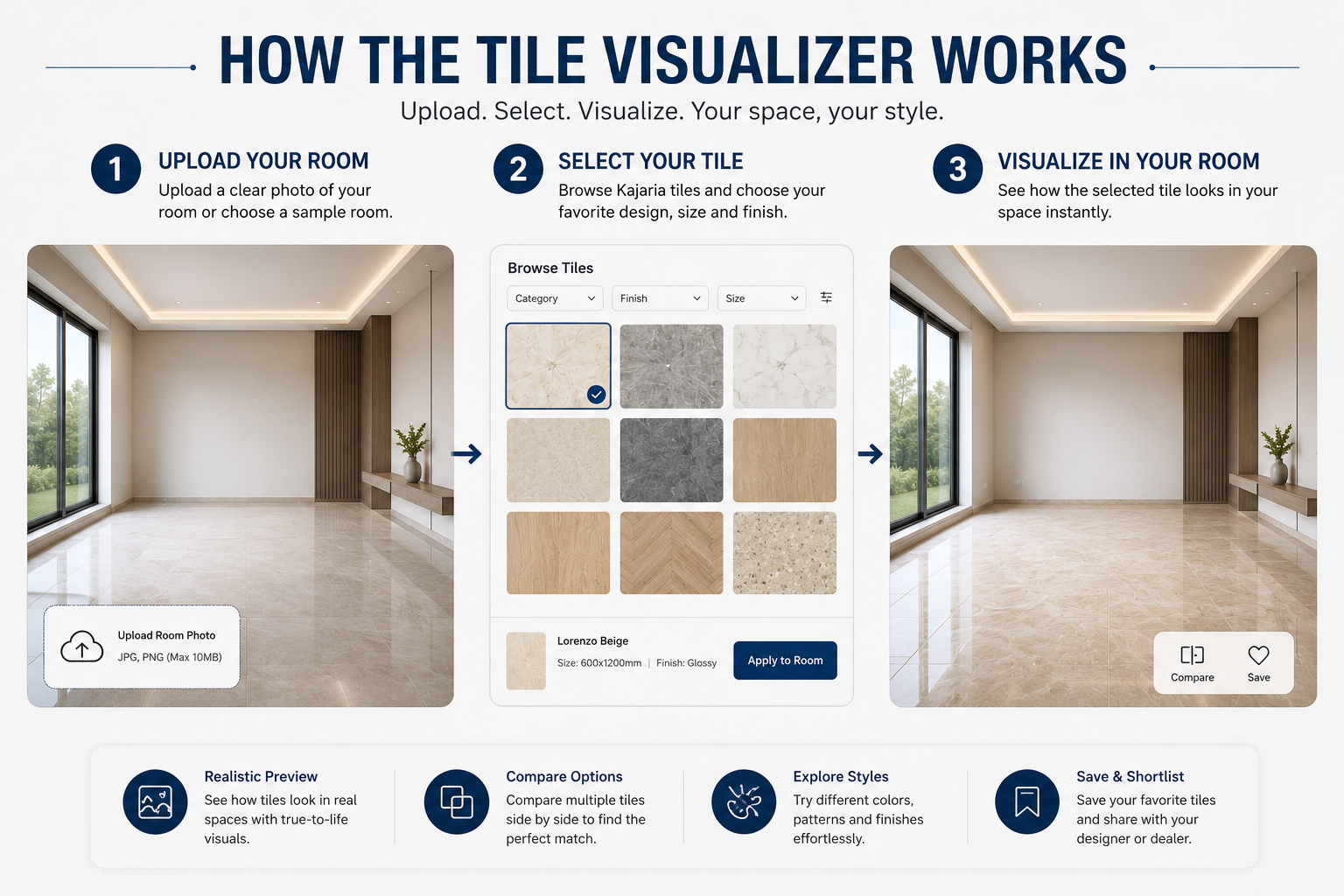
The process of using a visualization tool can be relatively simple.
The customer can upload a photograph of the living room, bedroom, kitchen, bathroom, or another space when the platform supports image-based visualization.
The customer's own room provides a much more relevant context than a generic showroom image.
The user can determine whether they are exploring:
Different tile products can then be applied to the selected surface.
This allows the customer to move from product browsing to room-level exploration.
Customers can experiment with different:
Instead of trying to choose from the entire catalog, the customer can narrow the options down to a smaller group.
The final stage should still involve physical sample inspection and product verification.
Digital visualization helps answer:
"Does the design work visually?"
Physical evaluation helps answer:
"Does the actual product meet my requirements?"
Both questions matter.
One of the strongest customer intents behind digital tile visualization is the desire to see tiles in my room.
This makes sense because a generic product photograph cannot show how the tile will interact with the customer's existing environment.
Consider two homes using the same tile.
The first has:
The second has:
The same tile can create very different visual impressions in these two spaces.
This is why room-based visualization is useful.
Kajaria's AR experience allows users to capture their space and explore tile designs, bringing the visualization process closer to the customer's actual environment.
The more personalized the visualization becomes, the more useful it can be during product discovery.
A tile room visualizer provides a broader perspective than a conventional product photograph because it shows the relationship between the tile and the surrounding environment.
Consider a bathroom renovation where the customer has shortlisted four designs.
A light tile creates a simple background and allows fixtures to stand out.
The marble pattern introduces a more luxurious visual direction.
A geometric pattern creates a stronger decorative element.
A darker tile creates a dramatic appearance against lighter fixtures.
All four can work.
The important question is which one matches the customer's preferred aesthetic and existing design.
A tile room visualizer makes this comparison more tangible because the customer can assess the complete room rather than isolated products.
One of the biggest problems with traditional tile selection is the mental gap between a small sample and a completed installation.
A customer may look at a 60 × 60 cm sample and try to imagine how hundreds of those tiles will look across the floor.
That is not always easy.
When customers visualize tiles in a room, they can better understand the overall pattern, visual repetition, contrast, and relationship with other surfaces.
This is particularly valuable for:
The larger the visual impact of the product, the more useful room-level visualization can become.
Digital visualization should not be presented as a replacement for physical samples.
The two methods serve different purposes.
|
Physical Samples |
Digital Visualization |
|
Shows actual material |
Shows room-level context |
|
Allows texture inspection |
Shows overall visual effect |
|
Helps evaluate physical finish |
Makes comparison faster |
|
Useful for final verification |
Useful for initial exploration |
|
Limited number of samples |
Many designs can be explored |
|
Requires physical access |
Can often be used remotely |
The most effective approach is to combine both.
A customer could use digital tile visualization to narrow twenty possible products down to four. The four shortlisted products can then be examined physically before the final decision.
This makes the digital experience complementary rather than competitive with the traditional showroom.
Tile research increasingly happens outside the showroom.
Customers may discover products while browsing:
A tile visualizer app or mobile-friendly visualization experience can therefore make product exploration available wherever the customer begins their research.
For example, a homeowner could take a photograph of their living room, experiment with several flooring options, and then share the preferred visualization with their spouse or interior designer.
The customer does not necessarily need to complete the entire purchase online.
Instead, the visualization can help move the customer from:
"I have no idea what to choose."
to:
"These are the three options I want to investigate."
That is a meaningful improvement in the buying journey.
Tile design software has traditionally been associated with professional designers, architects, retailers, and visualization specialists.
Modern visualization platforms make similar capabilities easier for non-technical users.
A homeowner should not need to understand complex 3D modeling to explore tile options.
A useful interface can reduce the process to simple actions:
Upload → Select → Visualize → Compare → Save
This makes tile design software relevant to several groups.
They can explore possibilities before purchasing.
They can communicate concepts more effectively with clients.
They can use visualization during customer consultations.
They can make large catalogs more interactive.
They can demonstrate different combinations during customer conversations.
The technology is therefore useful because it supports decision-making, not simply because it is technically advanced.
A successful tile design tool should solve a genuine customer problem.
The visualization should ideally use actual products from the business's catalog.
Customers should be able to identify the product after they have visualized it.
A generic room can be useful for inspiration, but the ability to work with the customer's own room creates greater relevance.
Customers should be able to compare different tiles without restarting the entire process.
Businesses selling both flooring and wall products should ideally provide visualization options for both surfaces.
Customers may explore products from home, while traveling, in a showroom, or during a consultation.
Tile selection is often collaborative. Customers may want to send their preferred designs to:
These features can turn visualization from a simple experiment into a useful part of the buying process.
A virtual tile preview can be especially useful when a customer has already narrowed down their choices but remains uncertain about the final direction.
Imagine a homeowner comparing three living-room floors.
The first is warm beige.
The second is cool grey.
The third is wood-inspired.
Each may look attractive in the product catalog.
But the customer's existing furniture may immediately make one option more suitable than the others.
The virtual preview allows the customer to make that comparison within the same environment.
It can help answer questions such as:
This is where visualization provides practical value.
It makes sense to preview tiles before installation, but customers should understand that digital visualization is not a perfect prediction of the finished installation.
Several factors can create differences between the digital preview and the physical result:
Therefore, visualization should be treated as a design reference, not a guarantee.
A sensible decision-making process is:
Visualize → Shortlist → Check physical samples → Confirm specifications → Install
This approach combines the convenience of digital exploration with the reliability of physical product evaluation.
Traditional tile showrooms provide an important advantage: customers can see products in a physical environment.
Digital visualization brings part of that contextual experience into the online journey.
A conventional product catalog might show:
A digital showroom can add:
Kajaria's current digital approach illustrates this broader movement. The brand combines product discovery with digital experiences such as its Virtual Showroom, AR visualization, and image-based tile discovery.
This creates a bridge between online research and physical showroom evaluation.
The customer can start exploring from home, develop a shortlist, and then visit a physical location when they are ready to inspect the actual products.
The interesting lesson from Kajaria is not simply that a large tile brand uses visualization.
It is the relationship between large product choice and digital discovery.
When a company has thousands of possible products, customers need more than a bigger catalog. They need better ways to understand which products are relevant to their specific project.
Visualization can provide that additional layer.
A customer designing a minimalist apartment does not necessarily need to examine every available product. A customer renovating a luxury bathroom may have a completely different set of priorities.
The room becomes the filter.
Instead of asking customers to navigate the entire catalog first, visualization can help them explore products based on their intended space and design direction.
That is a powerful concept for the wider tile industry.
Kajaria's digital approach offers several lessons that can apply to manufacturers, distributors, retailers, and e-commerce businesses.
Adding more products is not enough. Customers also need tools that help them narrow down their choices.
A tile should not always be presented as an isolated product. Showing it within a room can make its design easier to understand.
People often need to compare several possibilities before they know what they actually want.
The customer should be able to move from a visual concept to an identifiable product.
Visualization can help customers create a shortlist, while physical samples can provide final confirmation.
A salesperson can use a visualization to explain different design directions rather than relying only on product photographs.
The objective should always be the same:
Make the buying decision easier and more informed.
The Kajaria example also demonstrates why visualization is becoming relevant beyond large established tile brands.
A manufacturer with a large product catalog may want to help customers explore hundreds of products more efficiently. A distributor may want to give dealers a stronger sales presentation. An offline retailer may want to help homeowners compare products during showroom consultations.
Similarly, an e-commerce business can use visualization to provide more context before a customer submits an inquiry or makes a purchase.
TilesDisplay offers visualization solutions designed for several business categories, including:
The important point is that visualization should not exist as an isolated feature.
It should connect the customer's journey:
Discover → Visualize → Compare → Shortlist → Enquire → Purchase
When that connection is built correctly, a visualization platform can become part of the sales process rather than simply another interactive element on a website.
A tile visualizer is a digital tool that allows users to preview tile products within a room or interior environment. Depending on the platform, customers may be able to upload a room photograph, select a predefined space, apply floor or wall tiles, and compare different designs.
It provides room-level context that product photographs and small samples cannot always provide. Customers can compare colors, patterns, finishes, and combinations before narrowing their choices.
Yes, when the visualization platform supports room-photo uploads or AR functionality. Kajaria currently promotes an AR experience that allows users to capture their space and experiment with different tile designs.
A tile visualizer app is a mobile or web-based application that allows customers to explore tile products digitally. Depending on the platform, it may support room uploads, surface selection, product comparison, and visualization.
Tile design software allows users or businesses to digitally explore tile layouts, products, surfaces, colors, patterns, and room combinations. Different platforms are designed for different audiences, including homeowners, designers, retailers, and manufacturers.
A tile design tool is an interactive system that helps users experiment with different tile products and design combinations. It can be used for customer visualization, professional design presentations, retail sales, or product discovery.
A tile room visualizer allows users to view tile products within a complete room rather than looking at individual product images. It can be particularly useful for comparing flooring and wall options.
Yes. A floor tile visualizer can help customers compare different flooring designs in living rooms, bedrooms, kitchens, bathrooms, and other spaces.
Yes. A wall tile visualizer can help customers compare colors, patterns, textures, and decorative wall options before installation.
A virtual tile preview is useful for understanding the general visual relationship between a product and a room, but it should not be treated as an exact prediction of the installed result. Lighting, grout, screen calibration, texture, and installation can affect the final appearance.
Yes. Customers should preview tiles before installation, especially when considering large-format, highly patterned, or visually dominant products. However, digital visualization should be combined with physical sample inspection and product specification checks.
The way customers explore tiles is changing.
Traditional showrooms, physical samples, catalogs, and professional recommendations remain important, but digital visualization adds something different: context.
Instead of seeing a tile as an isolated product, customers can explore how it may contribute to an entire room. They can compare alternatives, experiment with different design directions, and narrow their choices before making the final decision.
Kajaria provides a useful example of this transition. Its digital experiences demonstrate how an established tile brand can combine a broad product portfolio with visualization and interactive product discovery.
The real value is not simply the ability to create a digital room.
It is the ability to make a better-informed decision.
For customers, that can mean less uncertainty when choosing between different designs. For designers and sales professionals, it can make concepts easier to communicate. For manufacturers, retailers, distributors, and e-commerce businesses, visualization can become another way to connect product discovery with customer engagement.
The strongest tile-buying journey is therefore not digital versus physical.
It is:
Discover digitally → visualize the possibilities → compare designs → shortlist products → inspect physical samples → make the final decision.
That is where digital visualization becomes more than a technology feature. It becomes a practical tool for helping customers understand tiles in the environment where they will ultimately be used.